 ## 容器创建
```java
public class AnnotationMainTest {
public static void main(String[] args) {
ApplicationContext applicationContext =
new AnnotationConfigApplicationContext(MainConfig.class);
}
```
### AnnotationConfigApplicationContext有参构造
```java
public AnnotationConfigApplicationContext(Class... componentClasses) {
this();
register(componentClasses);
refresh(); //容器完整刷新(创建出所有组件,组织好所有功能)
}
```
#### AnnotationConfigApplicationContext#this()无参构造
```java
// 上面的this()就是调用的这里
public AnnotationConfigApplicationContext() {
StartupStep createAnnotatedBeanDefReader = this.getApplicationStartup().start("spring.context.annotated-bean-reader.create");
this.reader = new AnnotatedBeanDefinitionReader(this);
createAnnotatedBeanDefReader.end();
this.scanner = new ClassPathBeanDefinitionScanner(this);
}
```
##### AnnotatedBeanDefinitionReader有参构造
```java
public AnnotatedBeanDefinitionReader(BeanDefinitionRegistry registry) {
this(registry, getOrCreateEnvironment(registry));
}
public AnnotatedBeanDefinitionReader(BeanDefinitionRegistry registry, Environment environment) {
Assert.notNull(registry, "BeanDefinitionRegistry must not be null");
Assert.notNull(environment, "Environment must not be null");
this.registry = registry;
this.conditionEvaluator = new ConditionEvaluator(registry, environment, null);
AnnotationConfigUtils.registerAnnotationConfigProcessors(this.registry);
}
```
##### AnnotationConfigUtils#registerAnnotationConfigProcessors()注册Spring内部几个核心组件
```java
/**
* The bean name of the internally managed Configuration annotation processor.
*/
public static final String CONFIGURATION_ANNOTATION_PROCESSOR_BEAN_NAME =
"org.springframework.context.annotation.internalConfigurationAnnotationProcessor";
/**
* The bean name of the internally managed BeanNameGenerator for use when processing
* {@link Configuration} classes. Set by {@link AnnotationConfigApplicationContext}
* and {@code AnnotationConfigWebApplicationContext} during bootstrap in order to make
* any custom name generation strategy available to the underlying
* {@link ConfigurationClassPostProcessor}.
* @since 3.1.1
*/
public static final String CONFIGURATION_BEAN_NAME_GENERATOR =
"org.springframework.context.annotation.internalConfigurationBeanNameGenerator";
/**
* The bean name of the internally managed Autowired annotation processor.
*/
public static final String AUTOWIRED_ANNOTATION_PROCESSOR_BEAN_NAME =
"org.springframework.context.annotation.internalAutowiredAnnotationProcessor";
/**
* The bean name of the internally managed Required annotation processor.
* @deprecated as of 5.1, since no Required processor is registered by default anymore
*/
@Deprecated
public static final String REQUIRED_ANNOTATION_PROCESSOR_BEAN_NAME =
"org.springframework.context.annotation.internalRequiredAnnotationProcessor";
/**
* The bean name of the internally managed JSR-250 annotation processor.
*/
public static final String COMMON_ANNOTATION_PROCESSOR_BEAN_NAME =
"org.springframework.context.annotation.internalCommonAnnotationProcessor";
/**
* The bean name of the internally managed JPA annotation processor.
*/
public static final String PERSISTENCE_ANNOTATION_PROCESSOR_BEAN_NAME =
"org.springframework.context.annotation.internalPersistenceAnnotationProcessor";
private static final String PERSISTENCE_ANNOTATION_PROCESSOR_CLASS_NAME =
"org.springframework.orm.jpa.support.PersistenceAnnotationBeanPostProcessor";
/**
* The bean name of the internally managed @EventListener annotation processor.
*/
public static final String EVENT_LISTENER_PROCESSOR_BEAN_NAME =
"org.springframework.context.event.internalEventListenerProcessor";
/**
* The bean name of the internally managed EventListenerFactory.
*/
public static final String EVENT_LISTENER_FACTORY_BEAN_NAME =
"org.springframework.context.event.internalEventListenerFactory";
public static void registerAnnotationConfigProcessors(BeanDefinitionRegistry registry) {
registerAnnotationConfigProcessors(registry, null);
}
public static Set
## 容器创建
```java
public class AnnotationMainTest {
public static void main(String[] args) {
ApplicationContext applicationContext =
new AnnotationConfigApplicationContext(MainConfig.class);
}
```
### AnnotationConfigApplicationContext有参构造
```java
public AnnotationConfigApplicationContext(Class... componentClasses) {
this();
register(componentClasses);
refresh(); //容器完整刷新(创建出所有组件,组织好所有功能)
}
```
#### AnnotationConfigApplicationContext#this()无参构造
```java
// 上面的this()就是调用的这里
public AnnotationConfigApplicationContext() {
StartupStep createAnnotatedBeanDefReader = this.getApplicationStartup().start("spring.context.annotated-bean-reader.create");
this.reader = new AnnotatedBeanDefinitionReader(this);
createAnnotatedBeanDefReader.end();
this.scanner = new ClassPathBeanDefinitionScanner(this);
}
```
##### AnnotatedBeanDefinitionReader有参构造
```java
public AnnotatedBeanDefinitionReader(BeanDefinitionRegistry registry) {
this(registry, getOrCreateEnvironment(registry));
}
public AnnotatedBeanDefinitionReader(BeanDefinitionRegistry registry, Environment environment) {
Assert.notNull(registry, "BeanDefinitionRegistry must not be null");
Assert.notNull(environment, "Environment must not be null");
this.registry = registry;
this.conditionEvaluator = new ConditionEvaluator(registry, environment, null);
AnnotationConfigUtils.registerAnnotationConfigProcessors(this.registry);
}
```
##### AnnotationConfigUtils#registerAnnotationConfigProcessors()注册Spring内部几个核心组件
```java
/**
* The bean name of the internally managed Configuration annotation processor.
*/
public static final String CONFIGURATION_ANNOTATION_PROCESSOR_BEAN_NAME =
"org.springframework.context.annotation.internalConfigurationAnnotationProcessor";
/**
* The bean name of the internally managed BeanNameGenerator for use when processing
* {@link Configuration} classes. Set by {@link AnnotationConfigApplicationContext}
* and {@code AnnotationConfigWebApplicationContext} during bootstrap in order to make
* any custom name generation strategy available to the underlying
* {@link ConfigurationClassPostProcessor}.
* @since 3.1.1
*/
public static final String CONFIGURATION_BEAN_NAME_GENERATOR =
"org.springframework.context.annotation.internalConfigurationBeanNameGenerator";
/**
* The bean name of the internally managed Autowired annotation processor.
*/
public static final String AUTOWIRED_ANNOTATION_PROCESSOR_BEAN_NAME =
"org.springframework.context.annotation.internalAutowiredAnnotationProcessor";
/**
* The bean name of the internally managed Required annotation processor.
* @deprecated as of 5.1, since no Required processor is registered by default anymore
*/
@Deprecated
public static final String REQUIRED_ANNOTATION_PROCESSOR_BEAN_NAME =
"org.springframework.context.annotation.internalRequiredAnnotationProcessor";
/**
* The bean name of the internally managed JSR-250 annotation processor.
*/
public static final String COMMON_ANNOTATION_PROCESSOR_BEAN_NAME =
"org.springframework.context.annotation.internalCommonAnnotationProcessor";
/**
* The bean name of the internally managed JPA annotation processor.
*/
public static final String PERSISTENCE_ANNOTATION_PROCESSOR_BEAN_NAME =
"org.springframework.context.annotation.internalPersistenceAnnotationProcessor";
private static final String PERSISTENCE_ANNOTATION_PROCESSOR_CLASS_NAME =
"org.springframework.orm.jpa.support.PersistenceAnnotationBeanPostProcessor";
/**
* The bean name of the internally managed @EventListener annotation processor.
*/
public static final String EVENT_LISTENER_PROCESSOR_BEAN_NAME =
"org.springframework.context.event.internalEventListenerProcessor";
/**
* The bean name of the internally managed EventListenerFactory.
*/
public static final String EVENT_LISTENER_FACTORY_BEAN_NAME =
"org.springframework.context.event.internalEventListenerFactory";
public static void registerAnnotationConfigProcessors(BeanDefinitionRegistry registry) {
registerAnnotationConfigProcessors(registry, null);
}
public static Set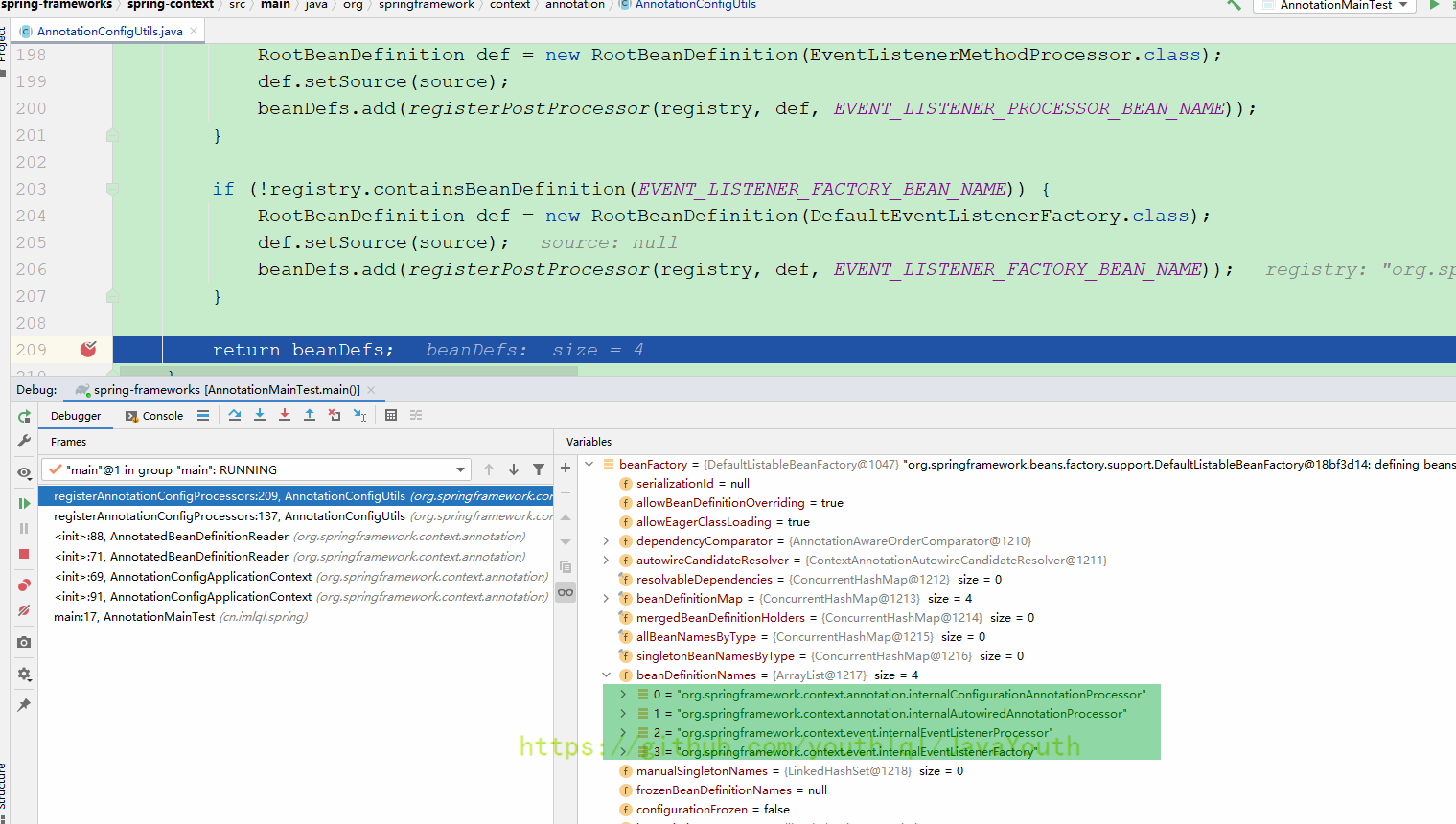 ##### RootBeanDefinition
```java
public RootBeanDefinition(@Nullable Class beanClass) {
super();
setBeanClass(beanClass);
}
```
##### AbstractBeanDefinition
```java
protected AbstractBeanDefinition() {
this(null, null);
}
```
##### ClassPathBeanDefinitionScanner
```java
public ClassPathBeanDefinitionScanner(BeanDefinitionRegistry registry, boolean useDefaultFilters,
Environment environment, @Nullable ResourceLoader resourceLoader) {
Assert.notNull(registry, "BeanDefinitionRegistry must not be null");
this.registry = registry;
if (useDefaultFilters) {
registerDefaultFilters();
}
setEnvironment(environment); //准备环境
setResourceLoader(resourceLoader);//准备资源加载器
}
```
#### AnnotationConfigApplicationContext#register()
```java
public void register(Class... componentClasses) {
//componentClasses就是咱们的配置类
Assert.notEmpty(componentClasses, "At least one component class must be specified");
StartupStep registerComponentClass = this.getApplicationStartup().start("spring.context.component-classes.register")
.tag("classes", () -> Arrays.toString(componentClasses));
this.reader.register(componentClasses);
registerComponentClass.end();
}
```
##### AnnotatedBeanDefinitionReader#register()注册主配置类BeanDefinition
```java
public void register(Class... componentClasses) {
for (Class componentClass : componentClasses) {
registerBean(componentClass);
}
}
public void registerBean(Class beanClass) {
doRegisterBean(beanClass, null, null, null, null);
}
private
##### RootBeanDefinition
```java
public RootBeanDefinition(@Nullable Class beanClass) {
super();
setBeanClass(beanClass);
}
```
##### AbstractBeanDefinition
```java
protected AbstractBeanDefinition() {
this(null, null);
}
```
##### ClassPathBeanDefinitionScanner
```java
public ClassPathBeanDefinitionScanner(BeanDefinitionRegistry registry, boolean useDefaultFilters,
Environment environment, @Nullable ResourceLoader resourceLoader) {
Assert.notNull(registry, "BeanDefinitionRegistry must not be null");
this.registry = registry;
if (useDefaultFilters) {
registerDefaultFilters();
}
setEnvironment(environment); //准备环境
setResourceLoader(resourceLoader);//准备资源加载器
}
```
#### AnnotationConfigApplicationContext#register()
```java
public void register(Class... componentClasses) {
//componentClasses就是咱们的配置类
Assert.notEmpty(componentClasses, "At least one component class must be specified");
StartupStep registerComponentClass = this.getApplicationStartup().start("spring.context.component-classes.register")
.tag("classes", () -> Arrays.toString(componentClasses));
this.reader.register(componentClasses);
registerComponentClass.end();
}
```
##### AnnotatedBeanDefinitionReader#register()注册主配置类BeanDefinition
```java
public void register(Class... componentClasses) {
for (Class componentClass : componentClasses) {
registerBean(componentClass);
}
}
public void registerBean(Class beanClass) {
doRegisterBean(beanClass, null, null, null, null);
}
private 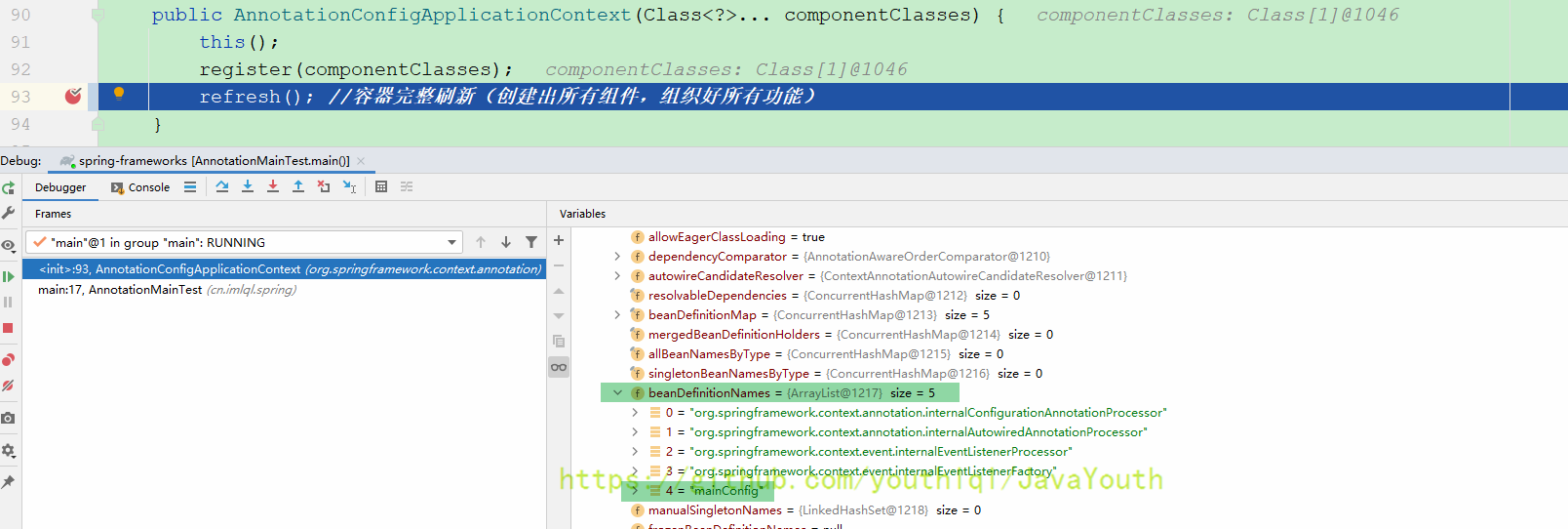 1. 接下来就是想办法让主配置类里的配置生效
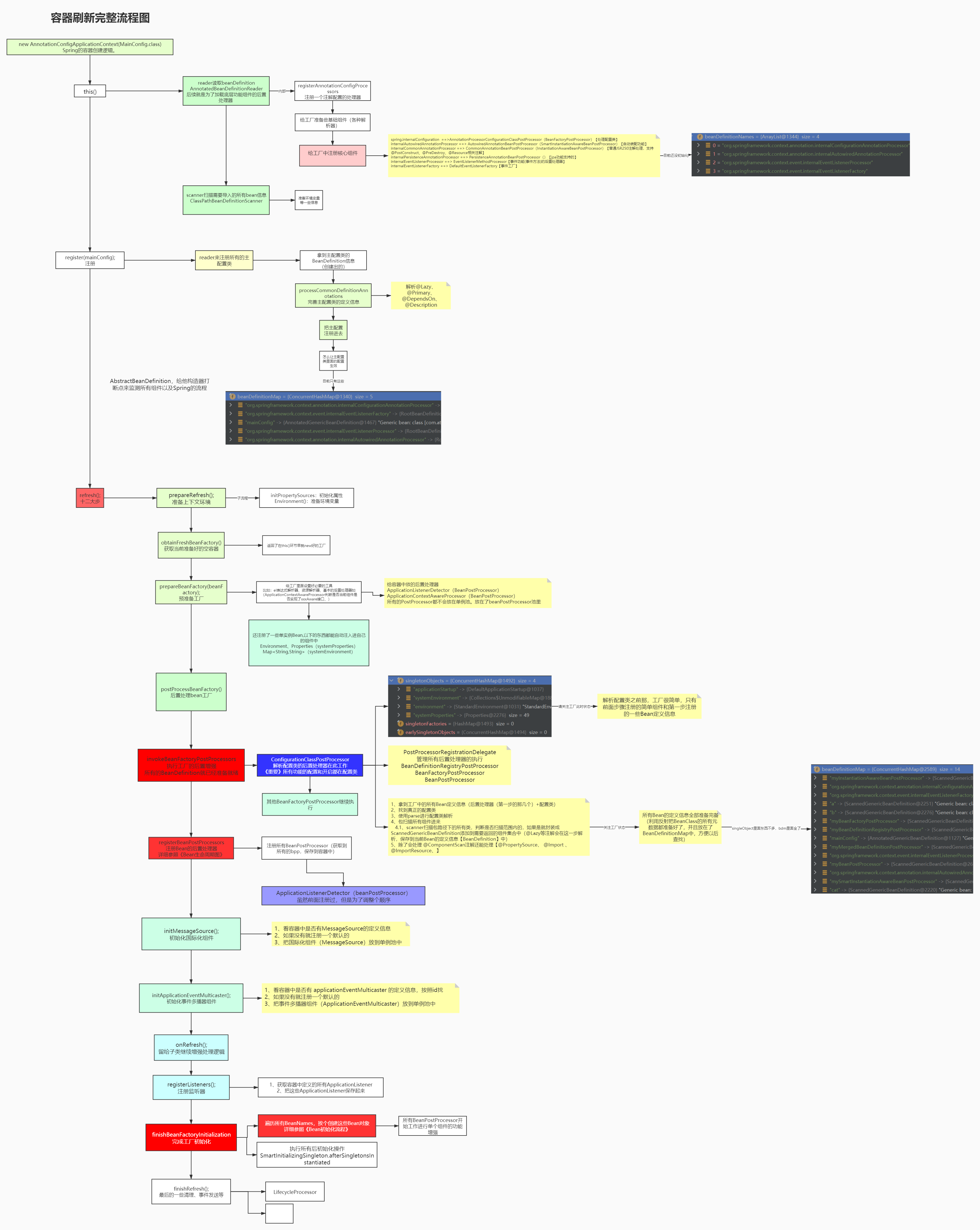
2. 目前Spring就靠上面的4个后置处理器和一个主配置类白手起家了,开始我们后面最重要的refresh()容器刷新流程了
## AbstractApplicationContext#refresh()开始容器刷新
```java
@Override //容器刷新的十二大步。模板模式
public void refresh() throws BeansException, IllegalStateException {
synchronized (this.startupShutdownMonitor) {
//容器启动过程状态的封装类
StartupStep contextRefresh = this.applicationStartup.start("spring.context.refresh");
//准备上下文环境 Prepare this context for refreshing.
prepareRefresh();
// Tell the subclass to refresh the internal bean factory.
// 工厂创建:BeanFactory第一次开始创建的时候,有xml解析逻辑。注解版这一步什么都没做,直接返回this()环节早就new好的工厂
ConfigurableListableBeanFactory beanFactory = obtainFreshBeanFactory();
//给容器中注册了环境信息作为单实例Bean方便后续自动装配;放了一些后置处理器处理(监听、xxAware功能) Prepare thebean factory for use in this context.
prepareBeanFactory(beanFactory);
try {
//留给子类的模板方法,允许子类继续对工厂执行一些处理; Allows post-processing of the bean factory in context subclasses.
postProcessBeanFactory(beanFactory);
StartupStep beanPostProcess = this.applicationStartup.start("spring.context.beans.post-process");
//【核心】工厂增强:执行所有的BeanFactory后置增强器;利用BeanFactory后置增强器对工厂进行修改或者增强,配置类会在这里进行解析。 Invoke factory processors registered as beans in the context.
invokeBeanFactoryPostProcessors(beanFactory);
//【核心】注册所有的Bean的后置处理器 Register bean processors that intercept bean creation.
registerBeanPostProcessors(beanFactory);
beanPostProcess.end();
//初始化国际化功能 Initialize message source for this context.
initMessageSource();
//初始化事件多播功能(事件派发) Initialize event multicaster for this context.
initApplicationEventMulticaster();
// Initialize other special beans in specific context subclasses.
onRefresh();
//注册监听器,从容器中获取所有的ApplicationListener; Check for listener beans and register them.
registerListeners();
// Instantiate all remaining (non-lazy-init) singletons.
//【大核心】bean创建;完成 BeanFactory 初始化。(工厂里面所有的组件都好了)
finishBeanFactoryInitialization(beanFactory);
//发布事件 Last step: publish corresponding event.
finishRefresh();
}
catch (BeansException ex) {
if (logger.isWarnEnabled()) {
logger.warn("Exception encountered during context initialization - " +
"cancelling refresh attempt: " + ex);
}
// Destroy already created singletons to avoid dangling resources.
destroyBeans();
// Reset 'active' flag.
cancelRefresh(ex);
// Propagate exception to caller.
throw ex;
}
finally {
// Reset common introspection caches in Spring's core, since we
// might not ever need metadata for singleton beans anymore...
resetCommonCaches();
contextRefresh.end();
}
}
}
```
### prepareRefresh()准备上下文环境
```java
protected void prepareRefresh() {
// Switch to active.
this.startupDate = System.currentTimeMillis();
this.closed.set(false);
this.active.set(true);
if (logger.isDebugEnabled()) {
if (logger.isTraceEnabled()) {
logger.trace("Refreshing " + this);
}
else {
logger.debug("Refreshing " + getDisplayName());
}
}
//其他子容器自行实现(比如:WebApplicationContext) Initialize any placeholder property sources in the context environment.
initPropertySources();
//准备环境变量信息 Validate that all properties marked as required are resolvable:
// see ConfigurablePropertyResolver#setRequiredProperties
getEnvironment().validateRequiredProperties();
// 存储子容器早期运行的一些监听器; Store pre-refresh ApplicationListeners...
if (this.earlyApplicationListeners == null) {
this.earlyApplicationListeners = new LinkedHashSet<>(this.applicationListeners);
}
else {
// Reset local application listeners to pre-refresh state.
this.applicationListeners.clear();
this.applicationListeners.addAll(this.earlyApplicationListeners);
}
//早期的一些事件存储到这里 Allow for the collection of early ApplicationEvents,
// to be published once the multicaster is available...
this.earlyApplicationEvents = new LinkedHashSet<>();
}
```
#### initPropertySources()
```java
protected void initPropertySources() {
// For subclasses: do nothing by default. 自行在此处加载一些自己感兴趣的信息。【WebApplicationContextUtils.initServletPropertySources】
// web-ioc容器启动的时候一般在此加载当前应用的上下文信息(ApplicationContext)
}
```
### prepareBeanFactory()给BeanFactory准备一些核心组件
```java
protected void prepareBeanFactory(ConfigurableListableBeanFactory beanFactory) {
// Tell the internal bean factory to use the context's class loader etc.
beanFactory.setBeanClassLoader(getClassLoader());
if (!shouldIgnoreSpel) { //解释器模式 ,解析el表达式
beanFactory.setBeanExpressionResolver(new StandardBeanExpressionResolver(beanFactory.getBeanClassLoader()));
}
beanFactory.addPropertyEditorRegistrar(new ResourceEditorRegistrar(this, getEnvironment()));
// Configure the bean factory with context callbacks.
beanFactory.addBeanPostProcessor(new ApplicationContextAwareProcessor(this)); //准备一个处理Aware接口功能的后置处理器
beanFactory.ignoreDependencyInterface(EnvironmentAware.class); //告诉Spring先别管这些接口
beanFactory.ignoreDependencyInterface(EmbeddedValueResolverAware.class);
beanFactory.ignoreDependencyInterface(ResourceLoaderAware.class);
beanFactory.ignoreDependencyInterface(ApplicationEventPublisherAware.class);
beanFactory.ignoreDependencyInterface(MessageSourceAware.class);
beanFactory.ignoreDependencyInterface(ApplicationContextAware.class);
beanFactory.ignoreDependencyInterface(ApplicationStartupAware.class);
/*
1.注册可以解析到的依赖,直接保存到容器的resolvableDependencies池里
2.意思就是在我们自定义的类中,我们可以直接用@Autowired注解注入下面4个东西,并直接使用
*/
beanFactory.registerResolvableDependency(BeanFactory.class, beanFactory);
beanFactory.registerResolvableDependency(ResourceLoader.class, this);
beanFactory.registerResolvableDependency(ApplicationEventPublisher.class, this);
beanFactory.registerResolvableDependency(ApplicationContext.class, this);
// 注册应用监听器的探测器,用来探测应用中有哪些监听器。这也是一个后置处理器
beanFactory.addBeanPostProcessor(new ApplicationListenerDetector(this));
// Detect a LoadTimeWeaver and prepare for weaving, if found.
if (!NativeDetector.inNativeImage() && beanFactory.containsBean(LOAD_TIME_WEAVER_BEAN_NAME)) {
beanFactory.addBeanPostProcessor(new LoadTimeWeaverAwareProcessor(beanFactory));
// Set a temporary ClassLoader for type matching.
beanFactory.setTempClassLoader(new ContextTypeMatchClassLoader(beanFactory.getBeanClassLoader()));
}
//注册默认组件: Register default environment beans.
if (!beanFactory.containsLocalBean(ENVIRONMENT_BEAN_NAME)) {
beanFactory.registerSingleton(ENVIRONMENT_BEAN_NAME, getEnvironment());
}
if (!beanFactory.containsLocalBean(SYSTEM_PROPERTIES_BEAN_NAME)) {
beanFactory.registerSingleton(SYSTEM_PROPERTIES_BEAN_NAME, getEnvironment().getSystemProperties());
}
if (!beanFactory.containsLocalBean(SYSTEM_ENVIRONMENT_BEAN_NAME)) {
beanFactory.registerSingleton(SYSTEM_ENVIRONMENT_BEAN_NAME, getEnvironment().getSystemEnvironment());
}
if (!beanFactory.containsLocalBean(APPLICATION_STARTUP_BEAN_NAME)) {
beanFactory.registerSingleton(APPLICATION_STARTUP_BEAN_NAME, getApplicationStartup());
}
}
String ENVIRONMENT_BEAN_NAME = "environment";
String SYSTEM_PROPERTIES_BEAN_NAME = "systemProperties";
String SYSTEM_ENVIRONMENT_BEAN_NAME = "systemEnvironment";
/**
* Name of the {@link ApplicationStartup} bean in the factory.
* @since 5.3
*/
String APPLICATION_STARTUP_BEAN_NAME = "applicationStartup";
```
### postProcessBeanFactory()留给子类的模板方法
这里是一个空方法,主要是留给子类实现,比如Web里的
```java
protected void postProcessBeanFactory(ConfigurableListableBeanFactory beanFactory) {
}
```
1. 接下来就是想办法让主配置类里的配置生效
2. 目前Spring就靠上面的4个后置处理器和一个主配置类白手起家了,开始我们后面最重要的refresh()容器刷新流程了
## AbstractApplicationContext#refresh()开始容器刷新
```java
@Override //容器刷新的十二大步。模板模式
public void refresh() throws BeansException, IllegalStateException {
synchronized (this.startupShutdownMonitor) {
//容器启动过程状态的封装类
StartupStep contextRefresh = this.applicationStartup.start("spring.context.refresh");
//准备上下文环境 Prepare this context for refreshing.
prepareRefresh();
// Tell the subclass to refresh the internal bean factory.
// 工厂创建:BeanFactory第一次开始创建的时候,有xml解析逻辑。注解版这一步什么都没做,直接返回this()环节早就new好的工厂
ConfigurableListableBeanFactory beanFactory = obtainFreshBeanFactory();
//给容器中注册了环境信息作为单实例Bean方便后续自动装配;放了一些后置处理器处理(监听、xxAware功能) Prepare thebean factory for use in this context.
prepareBeanFactory(beanFactory);
try {
//留给子类的模板方法,允许子类继续对工厂执行一些处理; Allows post-processing of the bean factory in context subclasses.
postProcessBeanFactory(beanFactory);
StartupStep beanPostProcess = this.applicationStartup.start("spring.context.beans.post-process");
//【核心】工厂增强:执行所有的BeanFactory后置增强器;利用BeanFactory后置增强器对工厂进行修改或者增强,配置类会在这里进行解析。 Invoke factory processors registered as beans in the context.
invokeBeanFactoryPostProcessors(beanFactory);
//【核心】注册所有的Bean的后置处理器 Register bean processors that intercept bean creation.
registerBeanPostProcessors(beanFactory);
beanPostProcess.end();
//初始化国际化功能 Initialize message source for this context.
initMessageSource();
//初始化事件多播功能(事件派发) Initialize event multicaster for this context.
initApplicationEventMulticaster();
// Initialize other special beans in specific context subclasses.
onRefresh();
//注册监听器,从容器中获取所有的ApplicationListener; Check for listener beans and register them.
registerListeners();
// Instantiate all remaining (non-lazy-init) singletons.
//【大核心】bean创建;完成 BeanFactory 初始化。(工厂里面所有的组件都好了)
finishBeanFactoryInitialization(beanFactory);
//发布事件 Last step: publish corresponding event.
finishRefresh();
}
catch (BeansException ex) {
if (logger.isWarnEnabled()) {
logger.warn("Exception encountered during context initialization - " +
"cancelling refresh attempt: " + ex);
}
// Destroy already created singletons to avoid dangling resources.
destroyBeans();
// Reset 'active' flag.
cancelRefresh(ex);
// Propagate exception to caller.
throw ex;
}
finally {
// Reset common introspection caches in Spring's core, since we
// might not ever need metadata for singleton beans anymore...
resetCommonCaches();
contextRefresh.end();
}
}
}
```
### prepareRefresh()准备上下文环境
```java
protected void prepareRefresh() {
// Switch to active.
this.startupDate = System.currentTimeMillis();
this.closed.set(false);
this.active.set(true);
if (logger.isDebugEnabled()) {
if (logger.isTraceEnabled()) {
logger.trace("Refreshing " + this);
}
else {
logger.debug("Refreshing " + getDisplayName());
}
}
//其他子容器自行实现(比如:WebApplicationContext) Initialize any placeholder property sources in the context environment.
initPropertySources();
//准备环境变量信息 Validate that all properties marked as required are resolvable:
// see ConfigurablePropertyResolver#setRequiredProperties
getEnvironment().validateRequiredProperties();
// 存储子容器早期运行的一些监听器; Store pre-refresh ApplicationListeners...
if (this.earlyApplicationListeners == null) {
this.earlyApplicationListeners = new LinkedHashSet<>(this.applicationListeners);
}
else {
// Reset local application listeners to pre-refresh state.
this.applicationListeners.clear();
this.applicationListeners.addAll(this.earlyApplicationListeners);
}
//早期的一些事件存储到这里 Allow for the collection of early ApplicationEvents,
// to be published once the multicaster is available...
this.earlyApplicationEvents = new LinkedHashSet<>();
}
```
#### initPropertySources()
```java
protected void initPropertySources() {
// For subclasses: do nothing by default. 自行在此处加载一些自己感兴趣的信息。【WebApplicationContextUtils.initServletPropertySources】
// web-ioc容器启动的时候一般在此加载当前应用的上下文信息(ApplicationContext)
}
```
### prepareBeanFactory()给BeanFactory准备一些核心组件
```java
protected void prepareBeanFactory(ConfigurableListableBeanFactory beanFactory) {
// Tell the internal bean factory to use the context's class loader etc.
beanFactory.setBeanClassLoader(getClassLoader());
if (!shouldIgnoreSpel) { //解释器模式 ,解析el表达式
beanFactory.setBeanExpressionResolver(new StandardBeanExpressionResolver(beanFactory.getBeanClassLoader()));
}
beanFactory.addPropertyEditorRegistrar(new ResourceEditorRegistrar(this, getEnvironment()));
// Configure the bean factory with context callbacks.
beanFactory.addBeanPostProcessor(new ApplicationContextAwareProcessor(this)); //准备一个处理Aware接口功能的后置处理器
beanFactory.ignoreDependencyInterface(EnvironmentAware.class); //告诉Spring先别管这些接口
beanFactory.ignoreDependencyInterface(EmbeddedValueResolverAware.class);
beanFactory.ignoreDependencyInterface(ResourceLoaderAware.class);
beanFactory.ignoreDependencyInterface(ApplicationEventPublisherAware.class);
beanFactory.ignoreDependencyInterface(MessageSourceAware.class);
beanFactory.ignoreDependencyInterface(ApplicationContextAware.class);
beanFactory.ignoreDependencyInterface(ApplicationStartupAware.class);
/*
1.注册可以解析到的依赖,直接保存到容器的resolvableDependencies池里
2.意思就是在我们自定义的类中,我们可以直接用@Autowired注解注入下面4个东西,并直接使用
*/
beanFactory.registerResolvableDependency(BeanFactory.class, beanFactory);
beanFactory.registerResolvableDependency(ResourceLoader.class, this);
beanFactory.registerResolvableDependency(ApplicationEventPublisher.class, this);
beanFactory.registerResolvableDependency(ApplicationContext.class, this);
// 注册应用监听器的探测器,用来探测应用中有哪些监听器。这也是一个后置处理器
beanFactory.addBeanPostProcessor(new ApplicationListenerDetector(this));
// Detect a LoadTimeWeaver and prepare for weaving, if found.
if (!NativeDetector.inNativeImage() && beanFactory.containsBean(LOAD_TIME_WEAVER_BEAN_NAME)) {
beanFactory.addBeanPostProcessor(new LoadTimeWeaverAwareProcessor(beanFactory));
// Set a temporary ClassLoader for type matching.
beanFactory.setTempClassLoader(new ContextTypeMatchClassLoader(beanFactory.getBeanClassLoader()));
}
//注册默认组件: Register default environment beans.
if (!beanFactory.containsLocalBean(ENVIRONMENT_BEAN_NAME)) {
beanFactory.registerSingleton(ENVIRONMENT_BEAN_NAME, getEnvironment());
}
if (!beanFactory.containsLocalBean(SYSTEM_PROPERTIES_BEAN_NAME)) {
beanFactory.registerSingleton(SYSTEM_PROPERTIES_BEAN_NAME, getEnvironment().getSystemProperties());
}
if (!beanFactory.containsLocalBean(SYSTEM_ENVIRONMENT_BEAN_NAME)) {
beanFactory.registerSingleton(SYSTEM_ENVIRONMENT_BEAN_NAME, getEnvironment().getSystemEnvironment());
}
if (!beanFactory.containsLocalBean(APPLICATION_STARTUP_BEAN_NAME)) {
beanFactory.registerSingleton(APPLICATION_STARTUP_BEAN_NAME, getApplicationStartup());
}
}
String ENVIRONMENT_BEAN_NAME = "environment";
String SYSTEM_PROPERTIES_BEAN_NAME = "systemProperties";
String SYSTEM_ENVIRONMENT_BEAN_NAME = "systemEnvironment";
/**
* Name of the {@link ApplicationStartup} bean in the factory.
* @since 5.3
*/
String APPLICATION_STARTUP_BEAN_NAME = "applicationStartup";
```
### postProcessBeanFactory()留给子类的模板方法
这里是一个空方法,主要是留给子类实现,比如Web里的
```java
protected void postProcessBeanFactory(ConfigurableListableBeanFactory beanFactory) {
}
```
 ### invokeBeanFactoryPostProcessors()工厂增强【核心】
```java
protected void invokeBeanFactoryPostProcessors(ConfigurableListableBeanFactory beanFactory) {
PostProcessorRegistrationDelegate.invokeBeanFactoryPostProcessors(beanFactory, getBeanFactoryPostProcessors()); //执行所有的工厂增强器
//上面的类叫:后置处理器的注册代理(门面模式-装饰模式)
// Detect a LoadTimeWeaver and prepare for weaving, if found in the meantime
// (e.g. through an @Bean method registered by ConfigurationClassPostProcessor)
if (!NativeDetector.inNativeImage() && beanFactory.getTempClassLoader() == null && beanFactory.containsBean(LOAD_TIME_WEAVER_BEAN_NAME)) {
beanFactory.addBeanPostProcessor(new LoadTimeWeaverAwareProcessor(beanFactory));
beanFactory.setTempClassLoader(new ContextTypeMatchClassLoader(beanFactory.getBeanClassLoader()));
}
}
```
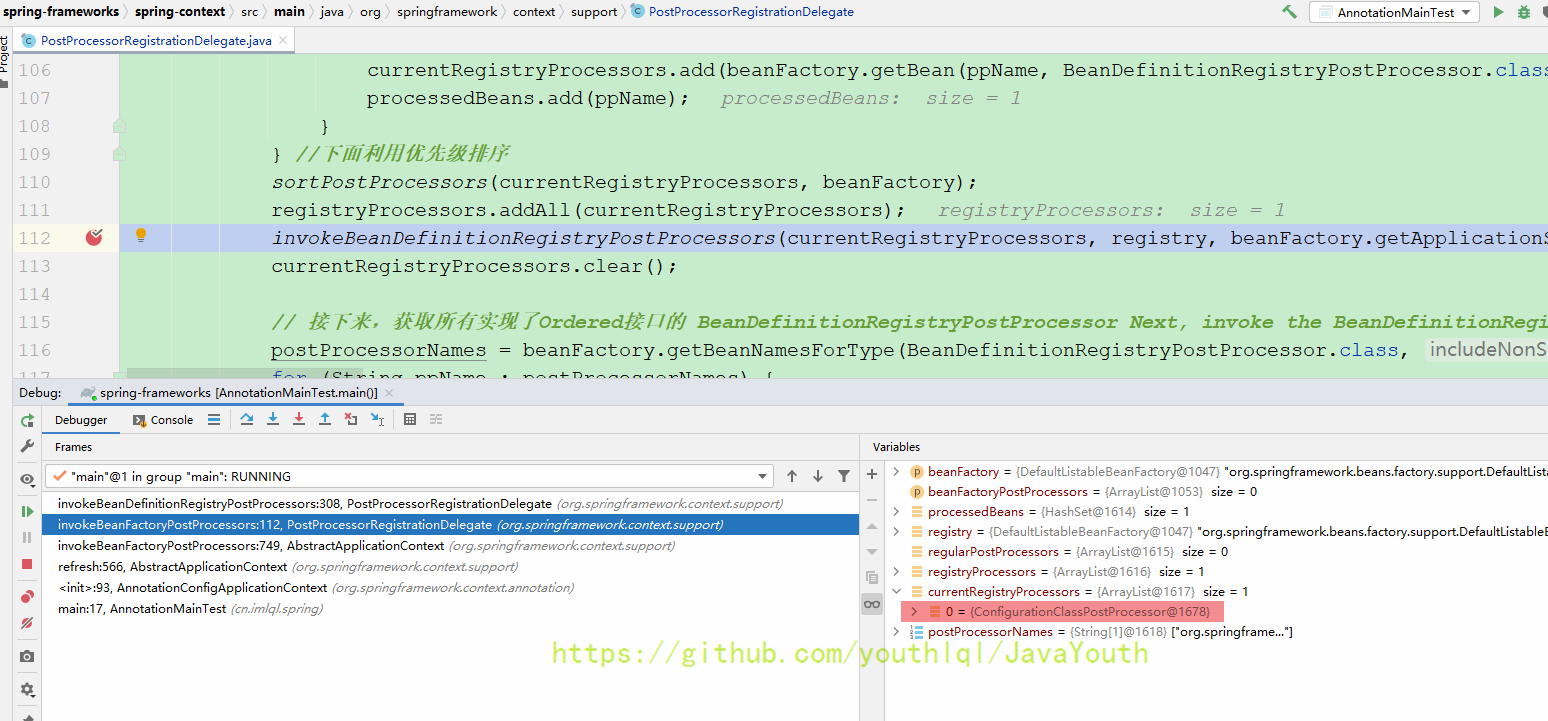
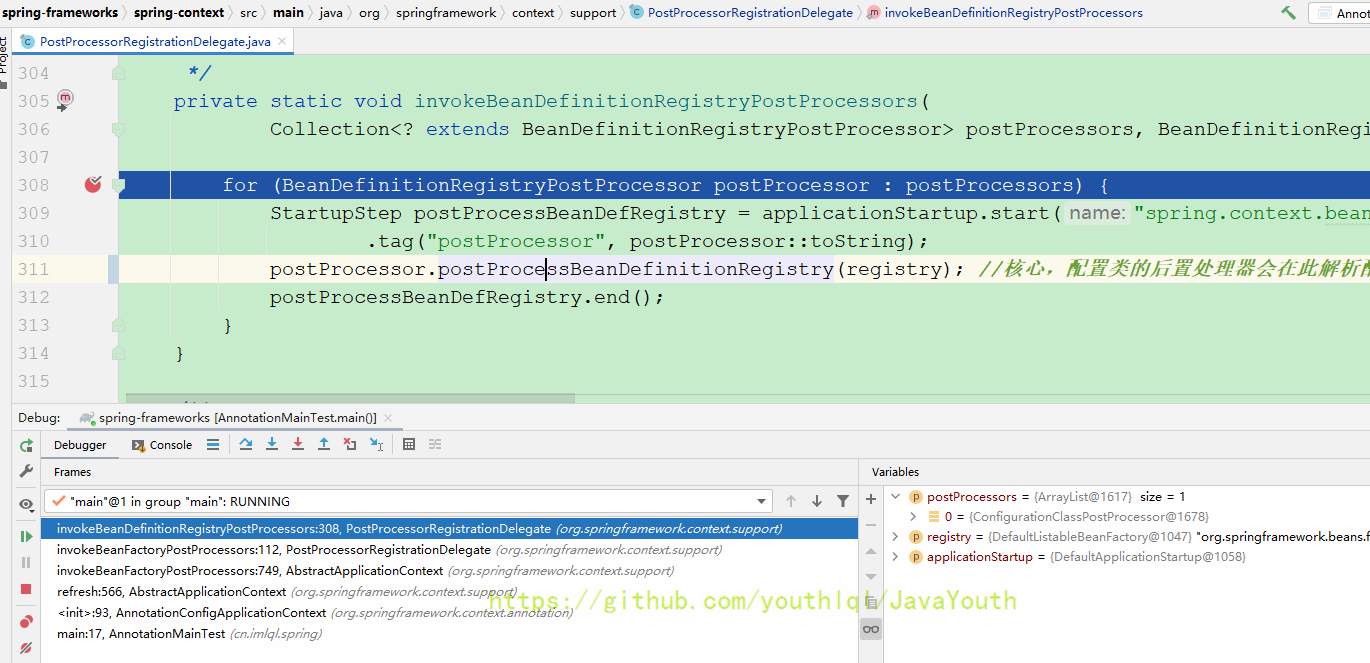
这一步有个很关键的后置处理器
### invokeBeanFactoryPostProcessors()工厂增强【核心】
```java
protected void invokeBeanFactoryPostProcessors(ConfigurableListableBeanFactory beanFactory) {
PostProcessorRegistrationDelegate.invokeBeanFactoryPostProcessors(beanFactory, getBeanFactoryPostProcessors()); //执行所有的工厂增强器
//上面的类叫:后置处理器的注册代理(门面模式-装饰模式)
// Detect a LoadTimeWeaver and prepare for weaving, if found in the meantime
// (e.g. through an @Bean method registered by ConfigurationClassPostProcessor)
if (!NativeDetector.inNativeImage() && beanFactory.getTempClassLoader() == null && beanFactory.containsBean(LOAD_TIME_WEAVER_BEAN_NAME)) {
beanFactory.addBeanPostProcessor(new LoadTimeWeaverAwareProcessor(beanFactory));
beanFactory.setTempClassLoader(new ContextTypeMatchClassLoader(beanFactory.getBeanClassLoader()));
}
}
```
这一步有个很关键的后置处理器
 #### ConfigurationClassPostProcessor#postProcessBeanDefinitionRegistry()开始解析@Configuration标注的所有配置类相关信息,并生成Bean
`AnnotationConfigApplicationContext#register()`这里解析的是主配置类
```java
@Override //把配置类中所有bean的定义信息导入进来。
public void postProcessBeanDefinitionRegistry(BeanDefinitionRegistry registry) {
int registryId = System.identityHashCode(registry);
if (this.registriesPostProcessed.contains(registryId)) {
throw new IllegalStateException(
"postProcessBeanDefinitionRegistry already called on this post-processor against " + registry);
}
if (this.factoriesPostProcessed.contains(registryId)) {
throw new IllegalStateException(
"postProcessBeanFactory already called on this post-processor against " + registry);
}
this.registriesPostProcessed.add(registryId);
processConfigBeanDefinitions(registry); //处理配置的BeanDefinition信息
}
public void processConfigBeanDefinitions(BeanDefinitionRegistry registry) {
List
#### ConfigurationClassPostProcessor#postProcessBeanDefinitionRegistry()开始解析@Configuration标注的所有配置类相关信息,并生成Bean
`AnnotationConfigApplicationContext#register()`这里解析的是主配置类
```java
@Override //把配置类中所有bean的定义信息导入进来。
public void postProcessBeanDefinitionRegistry(BeanDefinitionRegistry registry) {
int registryId = System.identityHashCode(registry);
if (this.registriesPostProcessed.contains(registryId)) {
throw new IllegalStateException(
"postProcessBeanDefinitionRegistry already called on this post-processor against " + registry);
}
if (this.factoriesPostProcessed.contains(registryId)) {
throw new IllegalStateException(
"postProcessBeanFactory already called on this post-processor against " + registry);
}
this.registriesPostProcessed.add(registryId);
processConfigBeanDefinitions(registry); //处理配置的BeanDefinition信息
}
public void processConfigBeanDefinitions(BeanDefinitionRegistry registry) {
List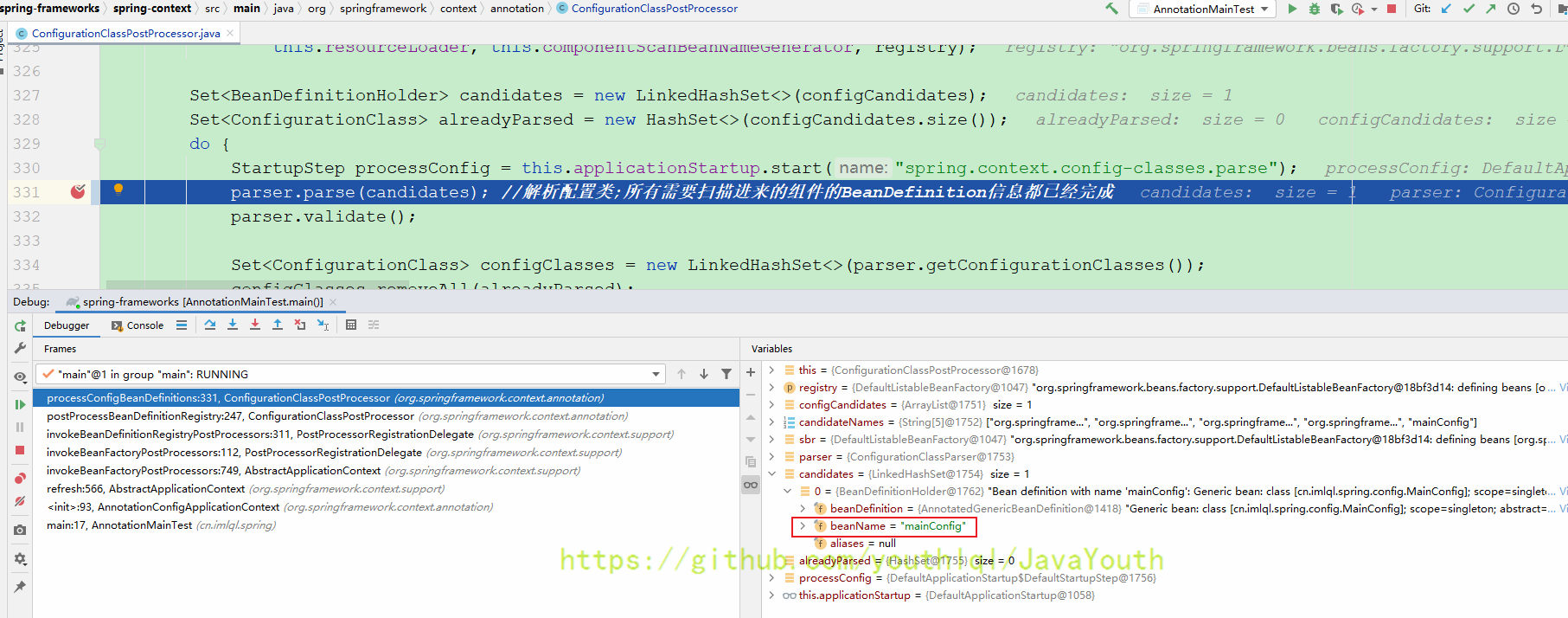 #### ConfigurationClassParser#parse()
```java
public void parse(Set
#### ConfigurationClassParser#parse()
```java
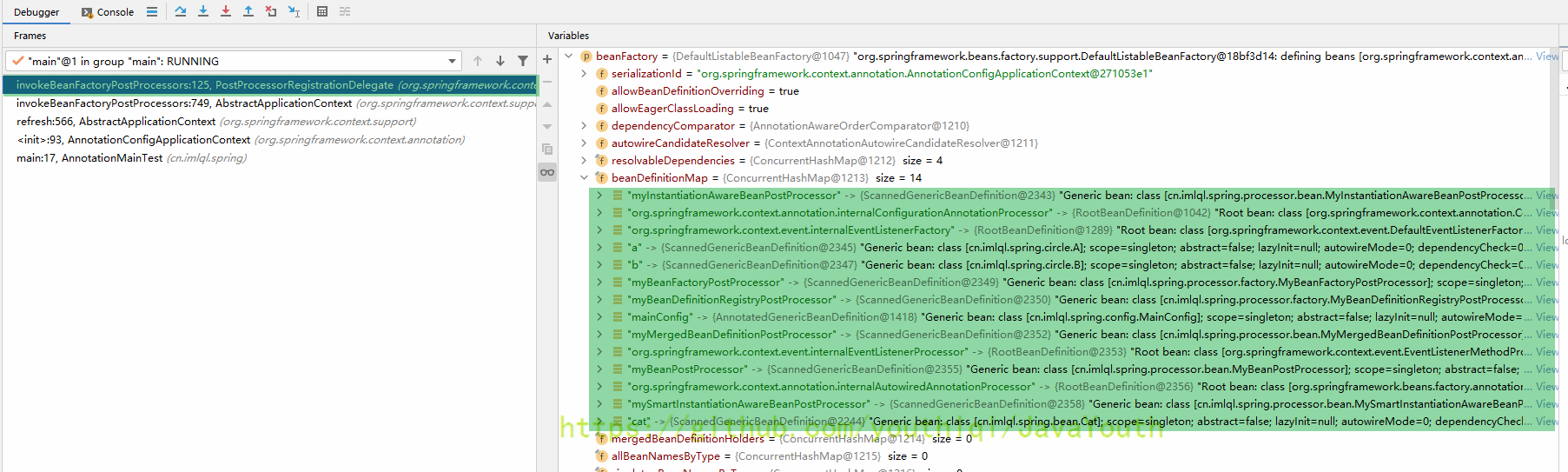
public void parse(Set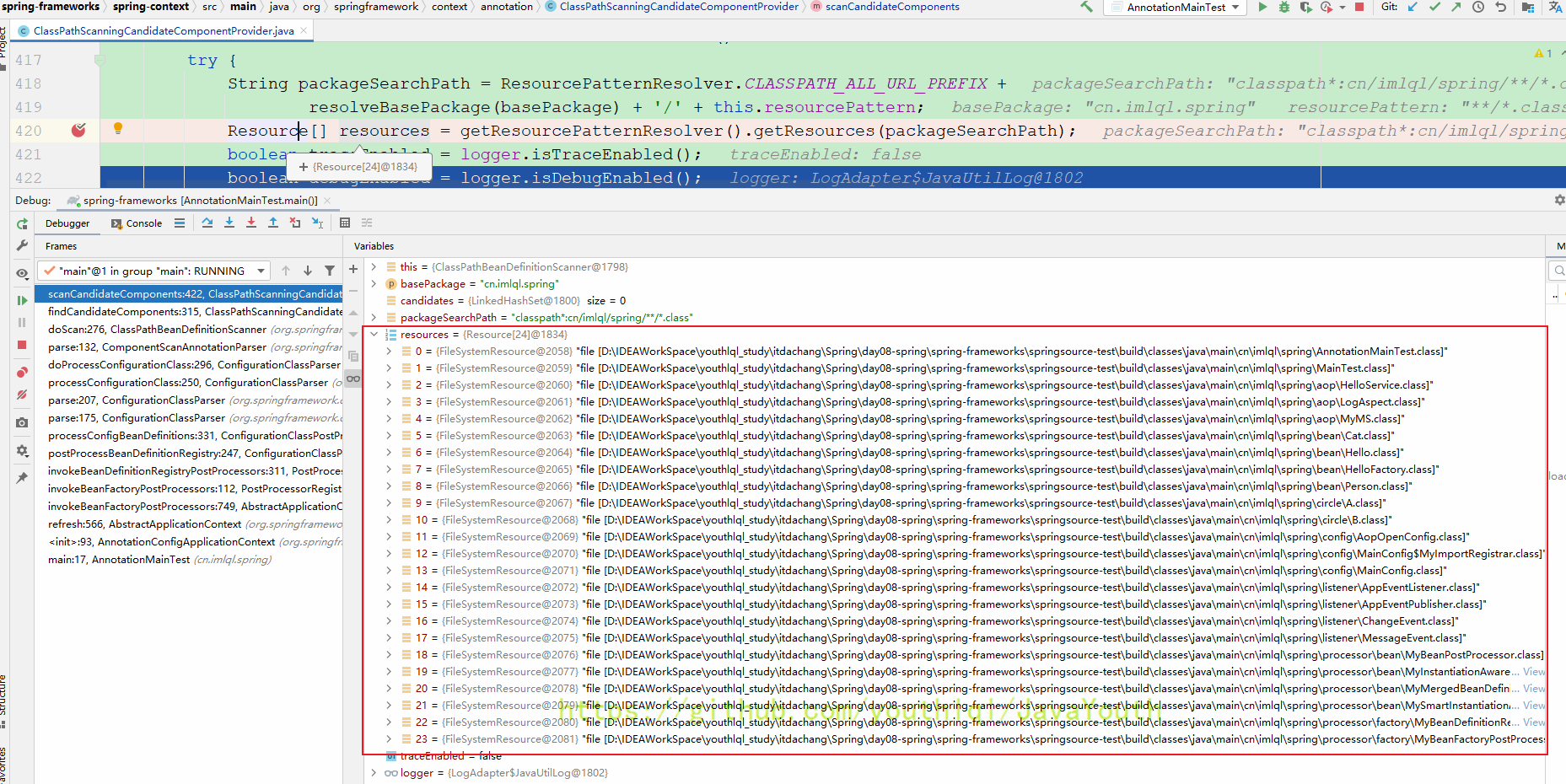 最后我们看一下执行完之后的BeanDefinition信息
 ### registerBeanPostProcessors()注册所有的Bean后置处理器
前面讲过
```java
protected void registerBeanPostProcessors(ConfigurableListableBeanFactory beanFactory) {
PostProcessorRegistrationDelegate.registerBeanPostProcessors(beanFactory, this);
}
```
#### PostProcessorRegistrationDelegate#registerBeanPostProcessors()
```java
public static void registerBeanPostProcessors(
ConfigurableListableBeanFactory beanFactory, AbstractApplicationContext applicationContext) {
// WARNING: Although it may appear that the body of this method can be easily
// refactored to avoid the use of multiple loops and multiple lists, the use
// of multiple lists and multiple passes over the names of processors is
// intentional. We must ensure that we honor the contracts for PriorityOrdered
// and Ordered processors. Specifically, we must NOT cause processors to be
// instantiated (via getBean() invocations) or registered in the ApplicationContext
// in the wrong order.
//
// Before submitting a pull request (PR) to change this method, please review the
// list of all declined PRs involving changes to PostProcessorRegistrationDelegate
// to ensure that your proposal does not result in a breaking change:
// https://github.com/spring-projects/spring-framework/issues?q=PostProcessorRegistrationDelegate+is%3Aclosed+label%3A%22status%3A+declined%22
//获取到容器中所有的 BeanPostProcessor; Bean的后置处理器
String[] postProcessorNames = beanFactory.getBeanNamesForType(BeanPostProcessor.class, true, false);
// Register BeanPostProcessorChecker that logs an info message when
// a bean is created during BeanPostProcessor instantiation, i.e. when
// a bean is not eligible for getting processed by all BeanPostProcessors.
int beanProcessorTargetCount = beanFactory.getBeanPostProcessorCount() + 1 + postProcessorNames.length;
beanFactory.addBeanPostProcessor(new BeanPostProcessorChecker(beanFactory, beanProcessorTargetCount));
// Separate between BeanPostProcessors that implement PriorityOrdered,
// Ordered, and the rest.
List
### registerBeanPostProcessors()注册所有的Bean后置处理器
前面讲过
```java
protected void registerBeanPostProcessors(ConfigurableListableBeanFactory beanFactory) {
PostProcessorRegistrationDelegate.registerBeanPostProcessors(beanFactory, this);
}
```
#### PostProcessorRegistrationDelegate#registerBeanPostProcessors()
```java
public static void registerBeanPostProcessors(
ConfigurableListableBeanFactory beanFactory, AbstractApplicationContext applicationContext) {
// WARNING: Although it may appear that the body of this method can be easily
// refactored to avoid the use of multiple loops and multiple lists, the use
// of multiple lists and multiple passes over the names of processors is
// intentional. We must ensure that we honor the contracts for PriorityOrdered
// and Ordered processors. Specifically, we must NOT cause processors to be
// instantiated (via getBean() invocations) or registered in the ApplicationContext
// in the wrong order.
//
// Before submitting a pull request (PR) to change this method, please review the
// list of all declined PRs involving changes to PostProcessorRegistrationDelegate
// to ensure that your proposal does not result in a breaking change:
// https://github.com/spring-projects/spring-framework/issues?q=PostProcessorRegistrationDelegate+is%3Aclosed+label%3A%22status%3A+declined%22
//获取到容器中所有的 BeanPostProcessor; Bean的后置处理器
String[] postProcessorNames = beanFactory.getBeanNamesForType(BeanPostProcessor.class, true, false);
// Register BeanPostProcessorChecker that logs an info message when
// a bean is created during BeanPostProcessor instantiation, i.e. when
// a bean is not eligible for getting processed by all BeanPostProcessors.
int beanProcessorTargetCount = beanFactory.getBeanPostProcessorCount() + 1 + postProcessorNames.length;
beanFactory.addBeanPostProcessor(new BeanPostProcessorChecker(beanFactory, beanProcessorTargetCount));
// Separate between BeanPostProcessors that implement PriorityOrdered,
// Ordered, and the rest.
List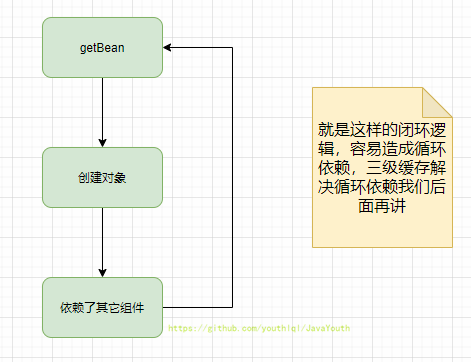 ## 核心代码
### AbstractBeanFactory
```java
protected
## 核心代码
### AbstractBeanFactory
```java
protected Checks already instantiated singletons and also allows for an early
* reference to a currently created singleton (resolving a circular reference).
* @param beanName the name of the bean to look for
* @param allowEarlyReference whether early references should be created or not
* @return the registered singleton object, or {@code null} if none found
*/
//☆☆☆ pos_4
@Nullable //双检查锁
protected Object getSingleton(String beanName, boolean allowEarlyReference) {
//先检查单例缓存池,获取当前对象 Quick check for existing instance without full singleton lock
Object singletonObject = this.singletonObjects.get(beanName); //一级缓存
if (singletonObject == null && isSingletonCurrentlyInCreation(beanName)) { //如果当前bean正在创建过程中,而且缓存中没有则继续
singletonObject = this.earlySingletonObjects.get(beanName); //二级
if (singletonObject == null && allowEarlyReference) {
synchronized (this.singletonObjects) {
// Consistent creation of early reference within full singleton lock
singletonObject = this.singletonObjects.get(beanName);
if (singletonObject == null) {
singletonObject = this.earlySingletonObjects.get(beanName);
if (singletonObject == null) {
ObjectFactory singletonFactory = this.singletonFactories.get(beanName); //三级
if (singletonFactory != null) {
singletonObject = singletonFactory.getObject();
this.earlySingletonObjects.put(beanName, singletonObject);
this.singletonFactories.remove(beanName);
}
}
}
}
}
}
return singletonObject;
}
// ☆☆☆ pos_5
public Object getSingleton(String beanName, ObjectFactory singletonFactory) {
Assert.notNull(beanName, "Bean name must not be null");
synchronized (this.singletonObjects) {
Object singletonObject = this.singletonObjects.get(beanName);//再检查一次单例池
if (singletonObject == null) { //单实例池子里面没有当前对象(说明没有创建完成)
if (this.singletonsCurrentlyInDestruction) {
throw new BeanCreationNotAllowedException(beanName,
"Singleton bean creation not allowed while singletons of this factory are in destruction " +
"(Do not request a bean from a BeanFactory in a destroy method implementation!)");
}
if (logger.isDebugEnabled()) {
logger.debug("Creating shared instance of singleton bean '" + beanName + "'");
}
// ☆☆☆ pos_6
beforeSingletonCreation(beanName); //单实例创建之前,这个就是加到
boolean newSingleton = false;
boolean recordSuppressedExceptions = (this.suppressedExceptions == null);
if (recordSuppressedExceptions) {
this.suppressedExceptions = new LinkedHashSet<>();
}
try {
singletonObject = singletonFactory.getObject();//会调用lamda表达式的内容,真正创建对象
newSingleton = true;
}
catch (IllegalStateException ex) {
// Has the singleton object implicitly appeared in the meantime ->
// if yes, proceed with it since the exception indicates that state.
// ☆☆☆ pos_7
singletonObject = this.singletonObjects.get(beanName);
if (singletonObject == null) {
throw ex;
}
}
catch (BeanCreationException ex) {
// ...
}
finally {
if (recordSuppressedExceptions) {
this.suppressedExceptions = null;
}
afterSingletonCreation(beanName);
}
if (newSingleton) {
addSingleton(beanName, singletonObject);
}
}
return singletonObject;
}
}
// 加到singletonsCurrentlyInCreation
protected void beforeSingletonCreation(String beanName) {
if (!this.inCreationCheckExclusions.contains(beanName) && !this.singletonsCurrentlyInCreation.add(beanName)) {
throw new BeanCurrentlyInCreationException(beanName);
}
}
```
### AbstractAutowireCapableBeanFactory
```java
protected Object doCreateBean(String beanName, RootBeanDefinition mbd, @Nullable Object[] args)
throws BeanCreationException {
// Instantiate the bean.
BeanWrapper instanceWrapper = null;
if (mbd.isSingleton()) { //是否单例的
instanceWrapper = this.factoryBeanInstanceCache.remove(beanName);
}
if (instanceWrapper == null) {
//创建Bean的实例,默认使用无参构造器创建的对象,组件的原始对象就创建了 ☆☆☆ pos_8
instanceWrapper = createBeanInstance(beanName, mbd, args);
}
Object bean = instanceWrapper.getWrappedInstance();
Class beanType = instanceWrapper.getWrappedClass();
if (beanType != NullBean.class) {
mbd.resolvedTargetType = beanType;
}
// ...
// 提前暴露单实例。专门来解决循环引用问题;Eagerly cache singletons to be able to resolve circular references
// even when triggered by lifecycle interfaces like BeanFactoryAware.
// ☆☆☆ pos_9
boolean earlySingletonExposure = (mbd.isSingleton() && this.allowCircularReferences &&
isSingletonCurrentlyInCreation(beanName));
if (earlySingletonExposure) {
if (logger.isTraceEnabled()) {
logger.trace("Eagerly caching bean '" + beanName +
"' to allow for resolving potential circular references");
}
addSingletonFactory(beanName, () -> getEarlyBeanReference(beanName, mbd, bean)); //三级缓存中的Bean也会被后置处理来增强,
}
// Initialize the bean instance.
Object exposedObject = bean;
try {
// ☆☆☆ pos_10
populateBean(beanName, mbd, instanceWrapper); //给创建好的对象每个属性进行赋值,@Autowired发生在这里
exposedObject = initializeBean(beanName, exposedObject, mbd);//初始化bean
}
catch (Throwable ex) {
if (ex instanceof BeanCreationException && beanName.equals(((BeanCreationException) ex).getBeanName())) {
throw (BeanCreationException) ex;
}
else {
throw new BeanCreationException(
mbd.getResourceDescription(), beanName, "Initialization of bean failed", ex);
}
}
//早期单实例暴露
if (earlySingletonExposure) {
Object earlySingletonReference = getSingleton(beanName, false); //检查早期缓存中是否存在这个组件
if (earlySingletonReference != null) {
if (exposedObject == bean) {
exposedObject = earlySingletonReference;
}
else if (!this.allowRawInjectionDespiteWrapping && hasDependentBean(beanName)) {
String[] dependentBeans = getDependentBeans(beanName);
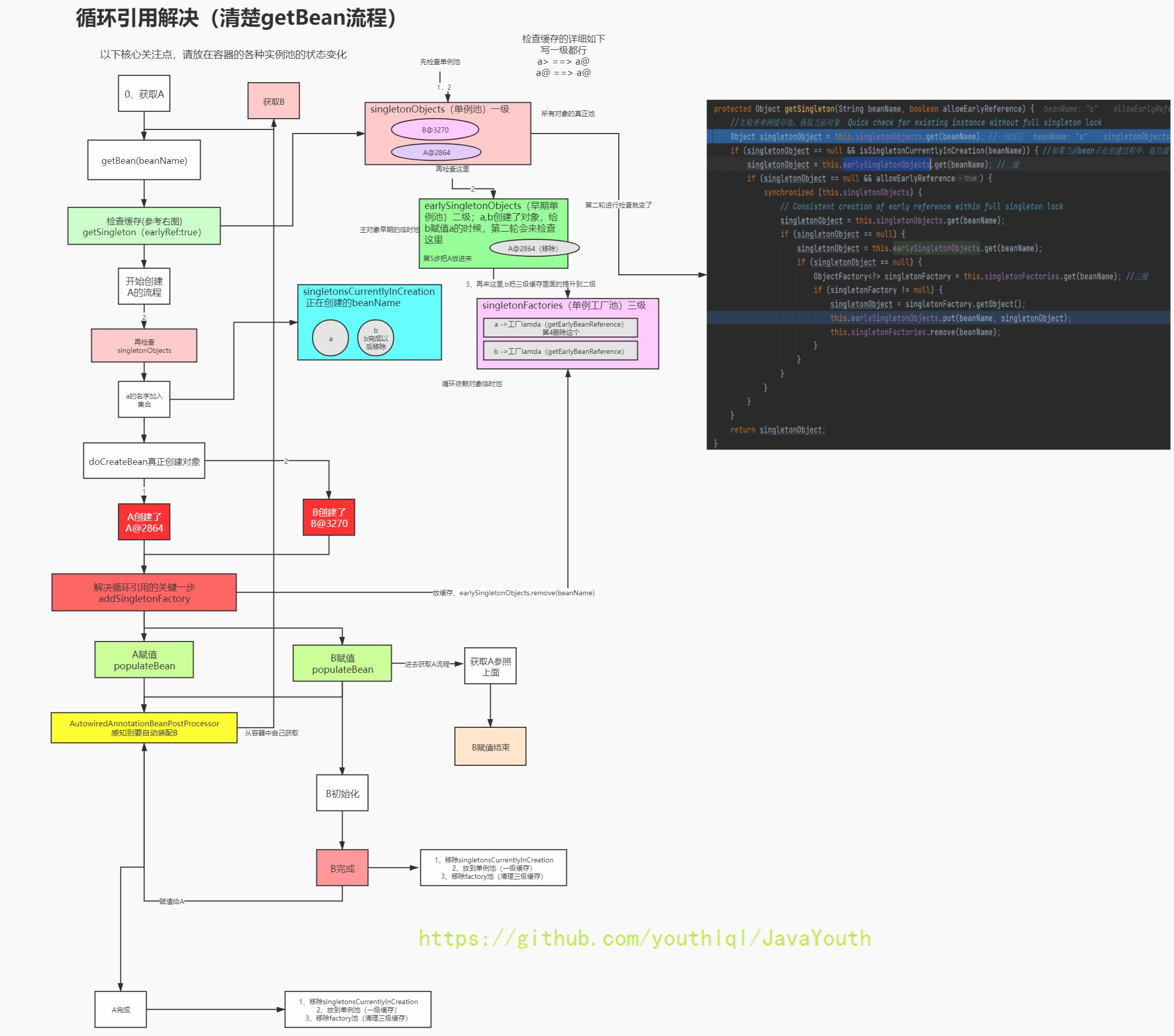
Set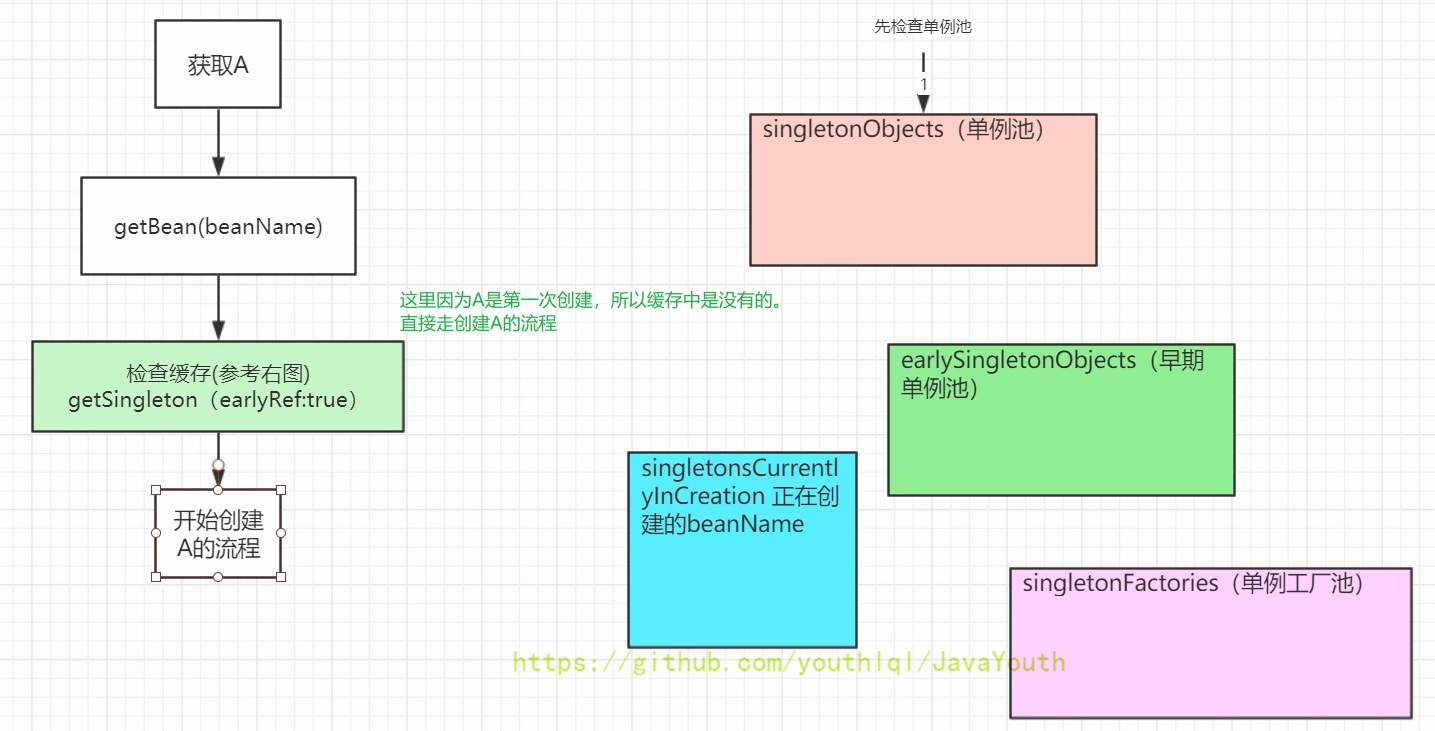 2. 然后走到pos_2调用pos_5的`getSingleton()`开始创建A的流程
3. 在pos_5的`getSingleton()`中走到pos_6的`beforeSingletonCreation()`,就变成下面这样
2. 然后走到pos_2调用pos_5的`getSingleton()`开始创建A的流程
3. 在pos_5的`getSingleton()`中走到pos_6的`beforeSingletonCreation()`,就变成下面这样
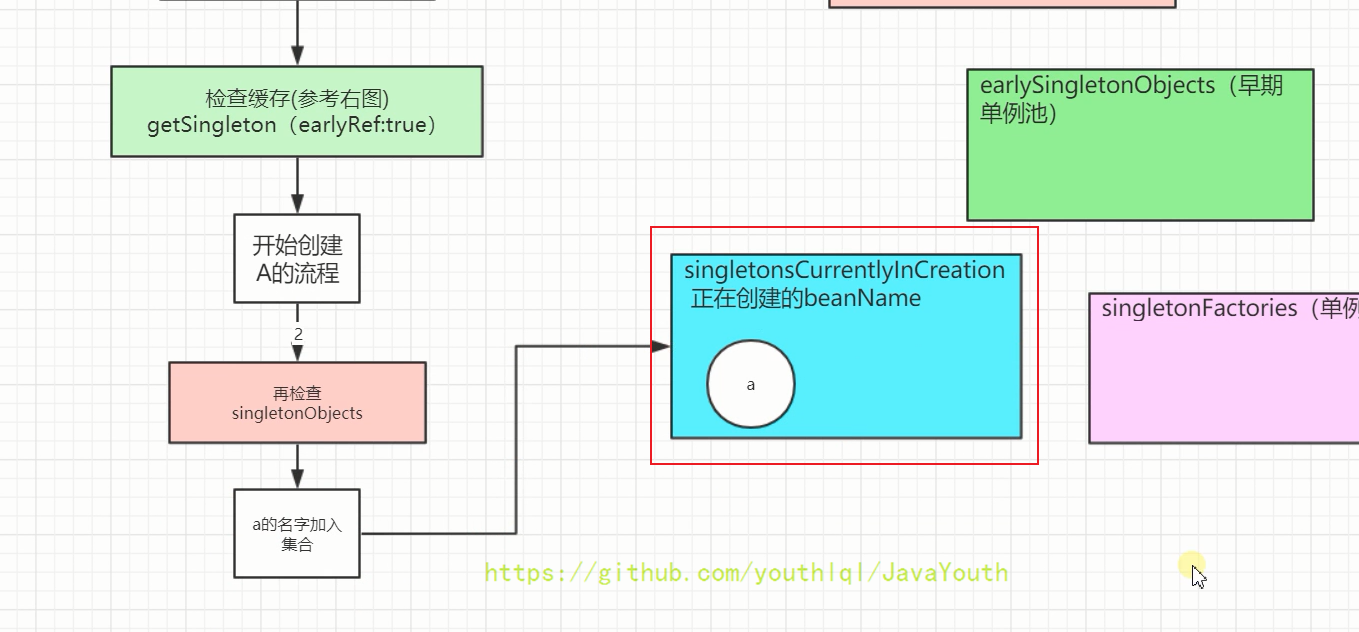 4. 接着pos_7的会调用pos_2的lamda表达式里的`createbean()`,里面再调用`doCreateBean()`。前面讲过不多说,最终调用A的无参构造(pos_8),创建完之后发现A的B属性是null。
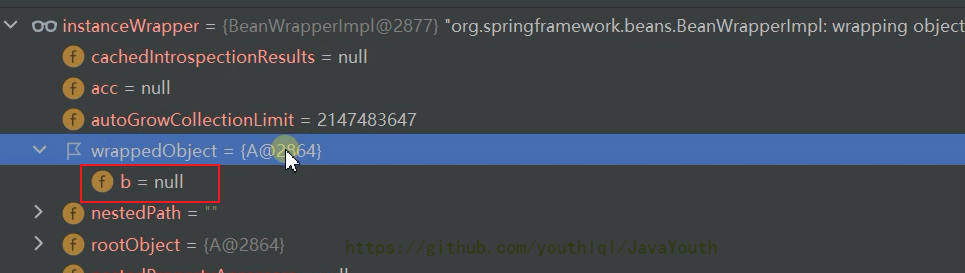 5.在pos_9处的`addSingletonFactory()`来准备解决循环引用
```java
protected void addSingletonFactory(String beanName, ObjectFactory singletonFactory) {
Assert.notNull(singletonFactory, "Singleton factory must not be null");
synchronized (this.singletonObjects) {
if (!this.singletonObjects.containsKey(beanName)) { //当前对象如果没有在单例池中
this.singletonFactories.put(beanName, singletonFactory);
this.earlySingletonObjects.remove(beanName);
this.registeredSingletons.add(beanName);
}
}
}
```
5.在pos_9处的`addSingletonFactory()`来准备解决循环引用
```java
protected void addSingletonFactory(String beanName, ObjectFactory singletonFactory) {
Assert.notNull(singletonFactory, "Singleton factory must not be null");
synchronized (this.singletonObjects) {
if (!this.singletonObjects.containsKey(beanName)) { //当前对象如果没有在单例池中
this.singletonFactories.put(beanName, singletonFactory);
this.earlySingletonObjects.remove(beanName);
this.registeredSingletons.add(beanName);
}
}
}
```
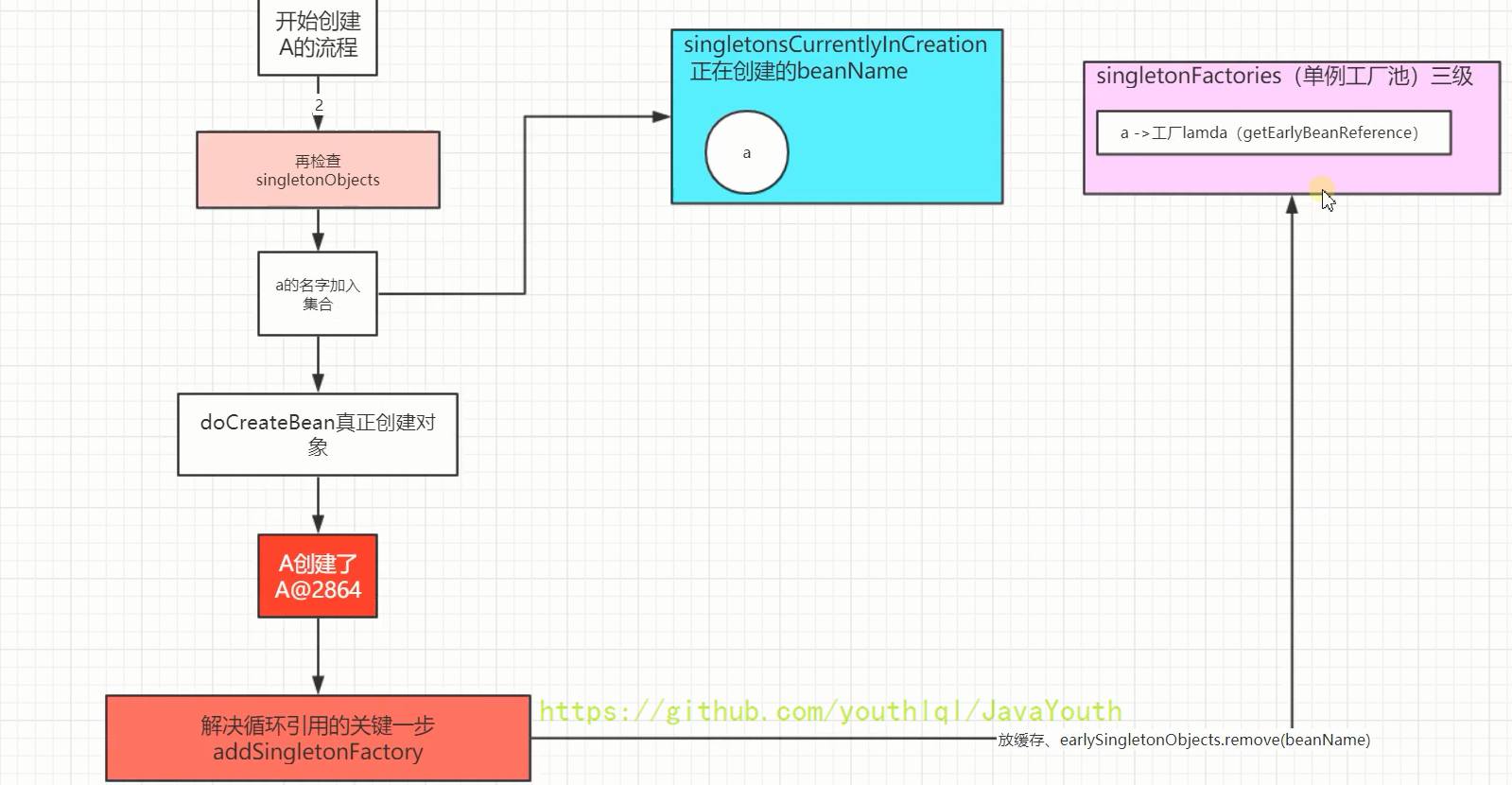 6. 接着在pos_10处的`populateBean()`开始给属性赋值,这一步就是要把`B b`自动装配进来。主要是
```java
protected void populateBean(String beanName, RootBeanDefinition mbd, @Nullable BeanWrapper bw) {
if (bw == null) {
if (mbd.hasPropertyValues()) {
throw new BeanCreationException(
mbd.getResourceDescription(), beanName, "Cannot apply property values to null instance");
}
else {
// Skip property population phase for null instance.
return;
}
}
// @Autowired赋值也在这里(但是没做事)。可以中断初始化行为; 在属性赋值之前,后置处理器可以提前准备些东西 Give any InstantiationAwareBeanPostProcessors the opportunity to modify the
if (!mbd.isSynthetic() && hasInstantiationAwareBeanPostProcessors()) {
for (InstantiationAwareBeanPostProcessor bp : getBeanPostProcessorCache().instantiationAware) {
if (!bp.postProcessAfterInstantiation(bw.getWrappedInstance(), beanName)) {
return;
}
}
} //以上的后置处理器可以中断以下的行为
PropertyValues pvs = (mbd.hasPropertyValues() ? mbd.getPropertyValues() : null);
int resolvedAutowireMode = mbd.getResolvedAutowireMode();
if (resolvedAutowireMode == AUTOWIRE_BY_NAME || resolvedAutowireMode == AUTOWIRE_BY_TYPE) {
// ...
}
boolean hasInstAwareBpps = hasInstantiationAwareBeanPostProcessors();
boolean needsDepCheck = (mbd.getDependencyCheck() != AbstractBeanDefinition.DEPENDENCY_CHECK_NONE);
PropertyDescriptor[] filteredPds = null;
if (hasInstAwareBpps) {
if (pvs == null) {
pvs = mbd.getPropertyValues(); //xml中property标签指定的
} //使用后置处理器处理属性
for (InstantiationAwareBeanPostProcessor bp : getBeanPostProcessorCache().instantiationAware) {
PropertyValues pvsToUse = bp.postProcessProperties(pvs, bw.getWrappedInstance(), beanName);
if (pvsToUse == null) {
if (filteredPds == null) {
filteredPds = filterPropertyDescriptorsForDependencyCheck(bw, mbd.allowCaching);
}
pvsToUse = bp.postProcessPropertyValues(pvs, filteredPds, bw.getWrappedInstance(), beanName);
if (pvsToUse == null) {
return;
}
}
pvs = pvsToUse; //封装了当前bean的所有属性名和值,可以由后置处理器处理得到
}
}
// ...
if (pvs != null) { //把以前处理好的PropertyValues给bean里面设置一下。主要是上面步骤没有给bean里面设置的属性
applyPropertyValues(beanName, mbd, bw, pvs); //xml版的所有配置会来到这里给属性赋值
}
}
```
通过前面讲过的AutowiredAnnotationBeanPostProcessor来注入B,最后发现要调用setB方法给B赋值
6. 接着在pos_10处的`populateBean()`开始给属性赋值,这一步就是要把`B b`自动装配进来。主要是
```java
protected void populateBean(String beanName, RootBeanDefinition mbd, @Nullable BeanWrapper bw) {
if (bw == null) {
if (mbd.hasPropertyValues()) {
throw new BeanCreationException(
mbd.getResourceDescription(), beanName, "Cannot apply property values to null instance");
}
else {
// Skip property population phase for null instance.
return;
}
}
// @Autowired赋值也在这里(但是没做事)。可以中断初始化行为; 在属性赋值之前,后置处理器可以提前准备些东西 Give any InstantiationAwareBeanPostProcessors the opportunity to modify the
if (!mbd.isSynthetic() && hasInstantiationAwareBeanPostProcessors()) {
for (InstantiationAwareBeanPostProcessor bp : getBeanPostProcessorCache().instantiationAware) {
if (!bp.postProcessAfterInstantiation(bw.getWrappedInstance(), beanName)) {
return;
}
}
} //以上的后置处理器可以中断以下的行为
PropertyValues pvs = (mbd.hasPropertyValues() ? mbd.getPropertyValues() : null);
int resolvedAutowireMode = mbd.getResolvedAutowireMode();
if (resolvedAutowireMode == AUTOWIRE_BY_NAME || resolvedAutowireMode == AUTOWIRE_BY_TYPE) {
// ...
}
boolean hasInstAwareBpps = hasInstantiationAwareBeanPostProcessors();
boolean needsDepCheck = (mbd.getDependencyCheck() != AbstractBeanDefinition.DEPENDENCY_CHECK_NONE);
PropertyDescriptor[] filteredPds = null;
if (hasInstAwareBpps) {
if (pvs == null) {
pvs = mbd.getPropertyValues(); //xml中property标签指定的
} //使用后置处理器处理属性
for (InstantiationAwareBeanPostProcessor bp : getBeanPostProcessorCache().instantiationAware) {
PropertyValues pvsToUse = bp.postProcessProperties(pvs, bw.getWrappedInstance(), beanName);
if (pvsToUse == null) {
if (filteredPds == null) {
filteredPds = filterPropertyDescriptorsForDependencyCheck(bw, mbd.allowCaching);
}
pvsToUse = bp.postProcessPropertyValues(pvs, filteredPds, bw.getWrappedInstance(), beanName);
if (pvsToUse == null) {
return;
}
}
pvs = pvsToUse; //封装了当前bean的所有属性名和值,可以由后置处理器处理得到
}
}
// ...
if (pvs != null) { //把以前处理好的PropertyValues给bean里面设置一下。主要是上面步骤没有给bean里面设置的属性
applyPropertyValues(beanName, mbd, bw, pvs); //xml版的所有配置会来到这里给属性赋值
}
}
```
通过前面讲过的AutowiredAnnotationBeanPostProcessor来注入B,最后发现要调用setB方法给B赋值
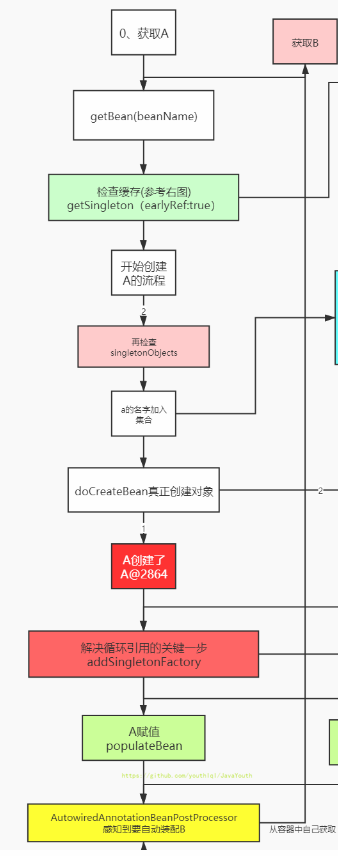
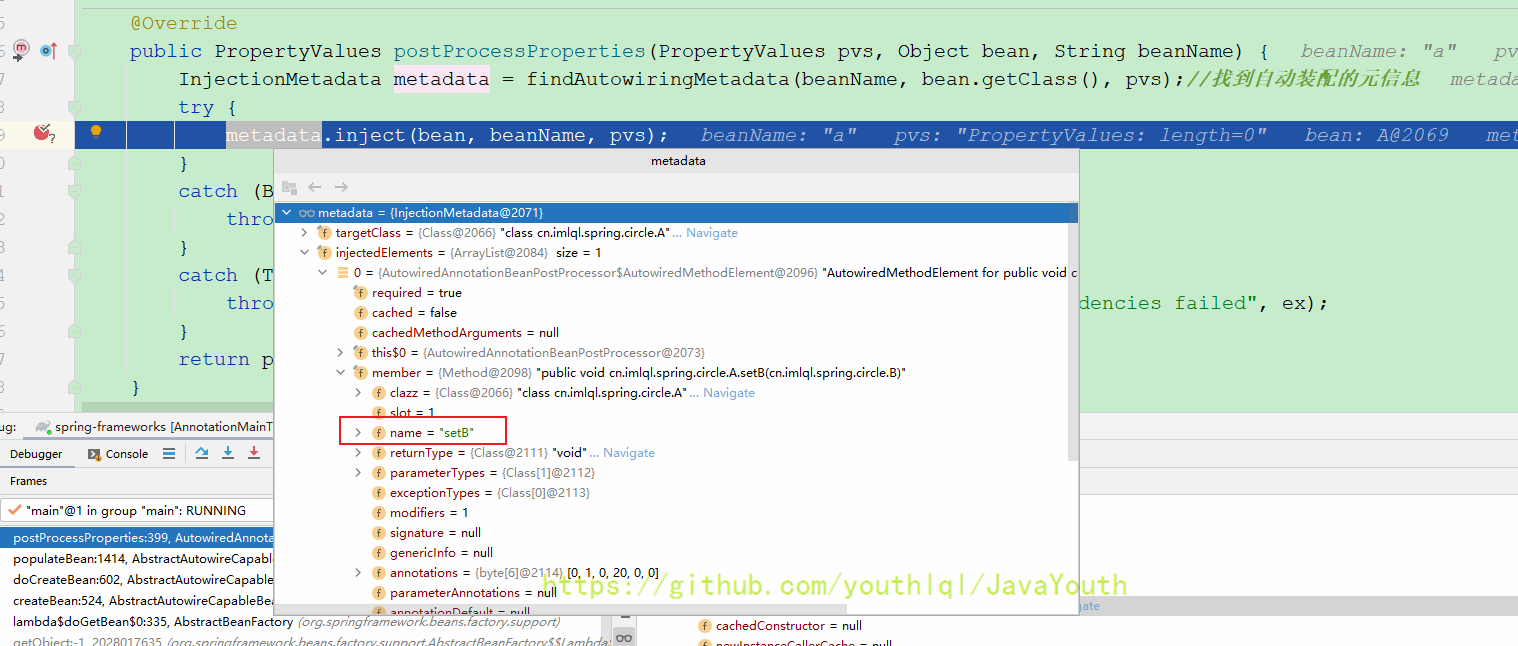 7. 继续走,发现要想获得B还是要调用getBean
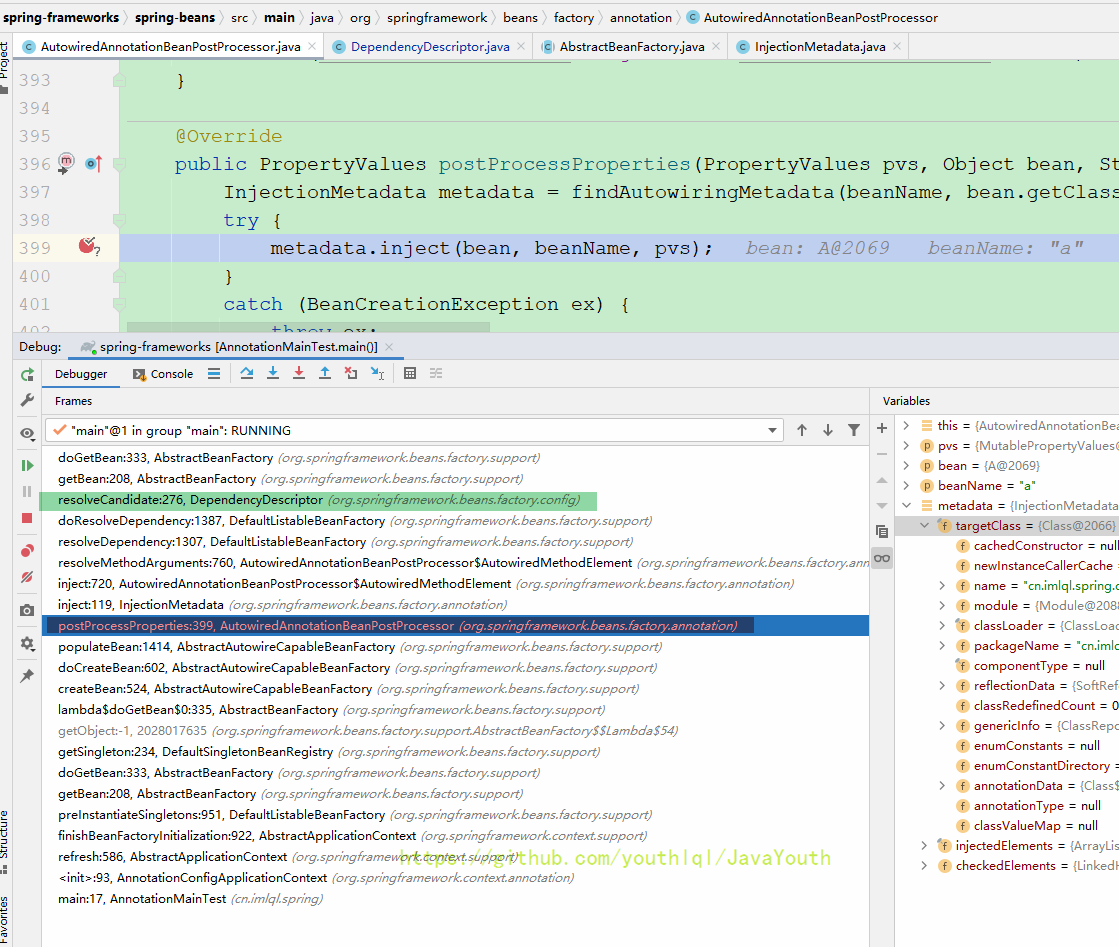 ```java
public Object resolveCandidate(String beanName, Class requiredType, BeanFactory beanFactory)
throws BeansException {
return beanFactory.getBean(beanName); //所有自动注入的属性都是beanFactory.getBean(beanName);的结果
}
```
然后图就是这样子
```java
public Object resolveCandidate(String beanName, Class requiredType, BeanFactory beanFactory)
throws BeansException {
return beanFactory.getBean(beanName); //所有自动注入的属性都是beanFactory.getBean(beanName);的结果
}
```
然后图就是这样子
 8. B也是走这一套
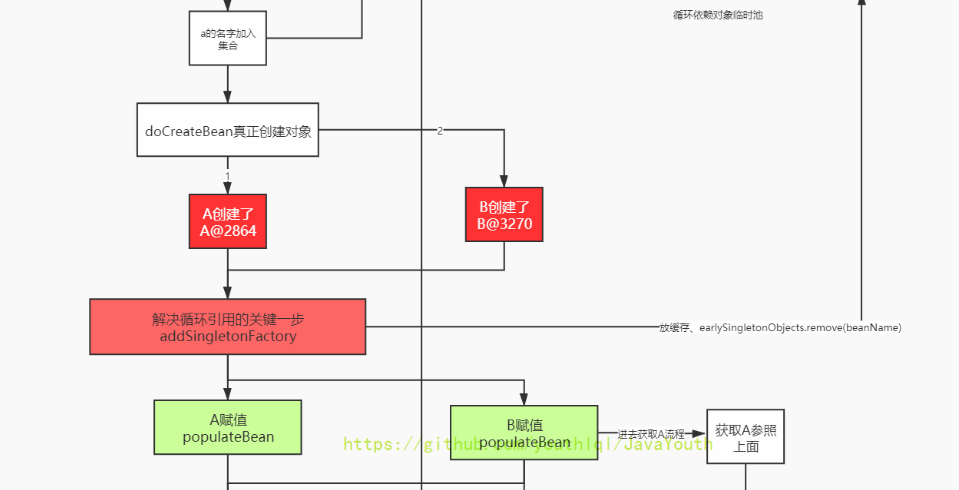 9. B为了获取A,还要再走一次getBean()流程,最终还是走到
```java
//☆☆☆ pos_4
@Nullable //双检查锁
protected Object getSingleton(String beanName, boolean allowEarlyReference) {
//先检查单例缓存池,获取当前对象 Quick check for existing instance without full singleton lock
Object singletonObject = this.singletonObjects.get(beanName); //一级缓存
if (singletonObject == null && isSingletonCurrentlyInCreation(beanName)) { //如果当前bean正在创建过程中,而且缓存中没有则继续
singletonObject = this.earlySingletonObjects.get(beanName); //二级
if (singletonObject == null && allowEarlyReference) {
synchronized (this.singletonObjects) {
// Consistent creation of early reference within full singleton lock
singletonObject = this.singletonObjects.get(beanName);
if (singletonObject == null) {
singletonObject = this.earlySingletonObjects.get(beanName);
if (singletonObject == null) {
ObjectFactory singletonFactory = this.singletonFactories.get(beanName); //三级
if (singletonFactory != null) {
singletonObject = singletonFactory.getObject();// 用那个lamda表达式拿对象
this.earlySingletonObjects.put(beanName, singletonObject);
this.singletonFactories.remove(beanName);
}
}
}
}
}
}
return singletonObject;
}
```
9. B为了获取A,还要再走一次getBean()流程,最终还是走到
```java
//☆☆☆ pos_4
@Nullable //双检查锁
protected Object getSingleton(String beanName, boolean allowEarlyReference) {
//先检查单例缓存池,获取当前对象 Quick check for existing instance without full singleton lock
Object singletonObject = this.singletonObjects.get(beanName); //一级缓存
if (singletonObject == null && isSingletonCurrentlyInCreation(beanName)) { //如果当前bean正在创建过程中,而且缓存中没有则继续
singletonObject = this.earlySingletonObjects.get(beanName); //二级
if (singletonObject == null && allowEarlyReference) {
synchronized (this.singletonObjects) {
// Consistent creation of early reference within full singleton lock
singletonObject = this.singletonObjects.get(beanName);
if (singletonObject == null) {
singletonObject = this.earlySingletonObjects.get(beanName);
if (singletonObject == null) {
ObjectFactory singletonFactory = this.singletonFactories.get(beanName); //三级
if (singletonFactory != null) {
singletonObject = singletonFactory.getObject();// 用那个lamda表达式拿对象
this.earlySingletonObjects.put(beanName, singletonObject);
this.singletonFactories.remove(beanName);
}
}
}
}
}
}
return singletonObject;
}
```
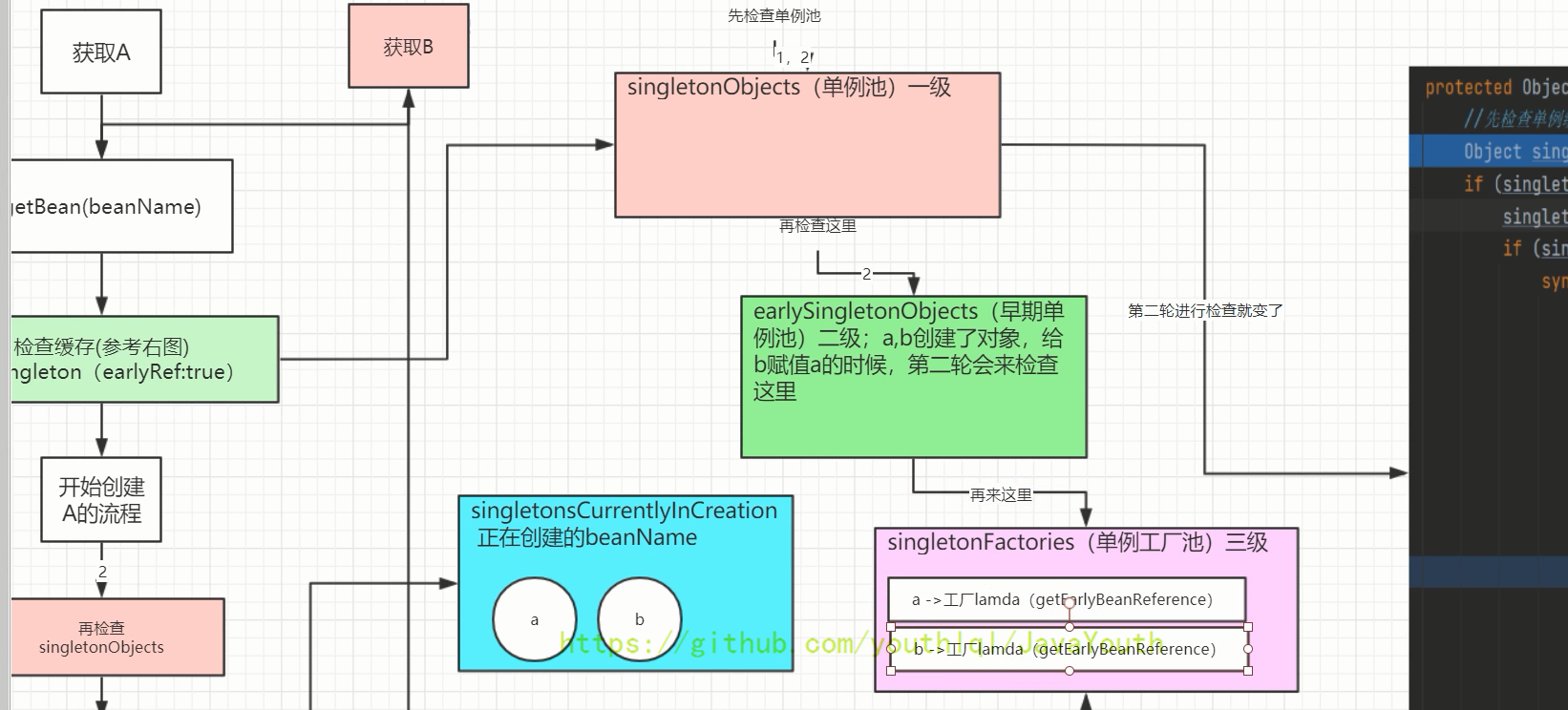 10.
10.
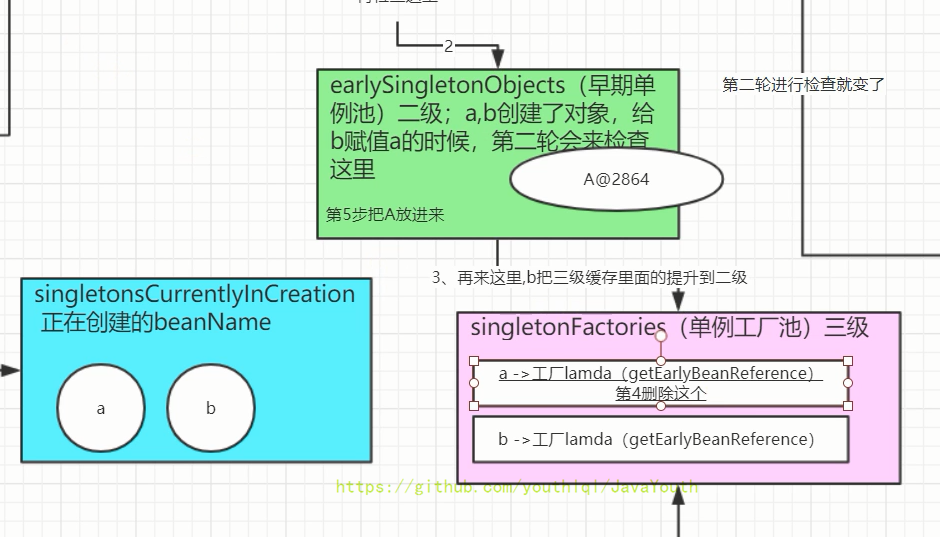 11. 得到A之后,B赋值结束。B进入初始化
```java
populateBean(beanName, mbd, instanceWrapper); //给创建好的对象每个属性进行赋值,@Autowired发生在这里
exposedObject = initializeBean(beanName, exposedObject, mbd);//初始化bean
```
12. B初始化完之后,回到getSingleton,把自己放到单例池里
11. 得到A之后,B赋值结束。B进入初始化
```java
populateBean(beanName, mbd, instanceWrapper); //给创建好的对象每个属性进行赋值,@Autowired发生在这里
exposedObject = initializeBean(beanName, exposedObject, mbd);//初始化bean
```
12. B初始化完之后,回到getSingleton,把自己放到单例池里
 ```java
protected void addSingleton(String beanName, Object singletonObject) {
synchronized (this.singletonObjects) {
this.singletonObjects.put(beanName, singletonObject);
this.singletonFactories.remove(beanName);
this.earlySingletonObjects.remove(beanName);
this.registeredSingletons.add(beanName);
}
}
```
```java
protected void addSingleton(String beanName, Object singletonObject) {
synchronized (this.singletonObjects) {
this.singletonObjects.put(beanName, singletonObject);
this.singletonFactories.remove(beanName);
this.earlySingletonObjects.remove(beanName);
this.registeredSingletons.add(beanName);
}
}
```
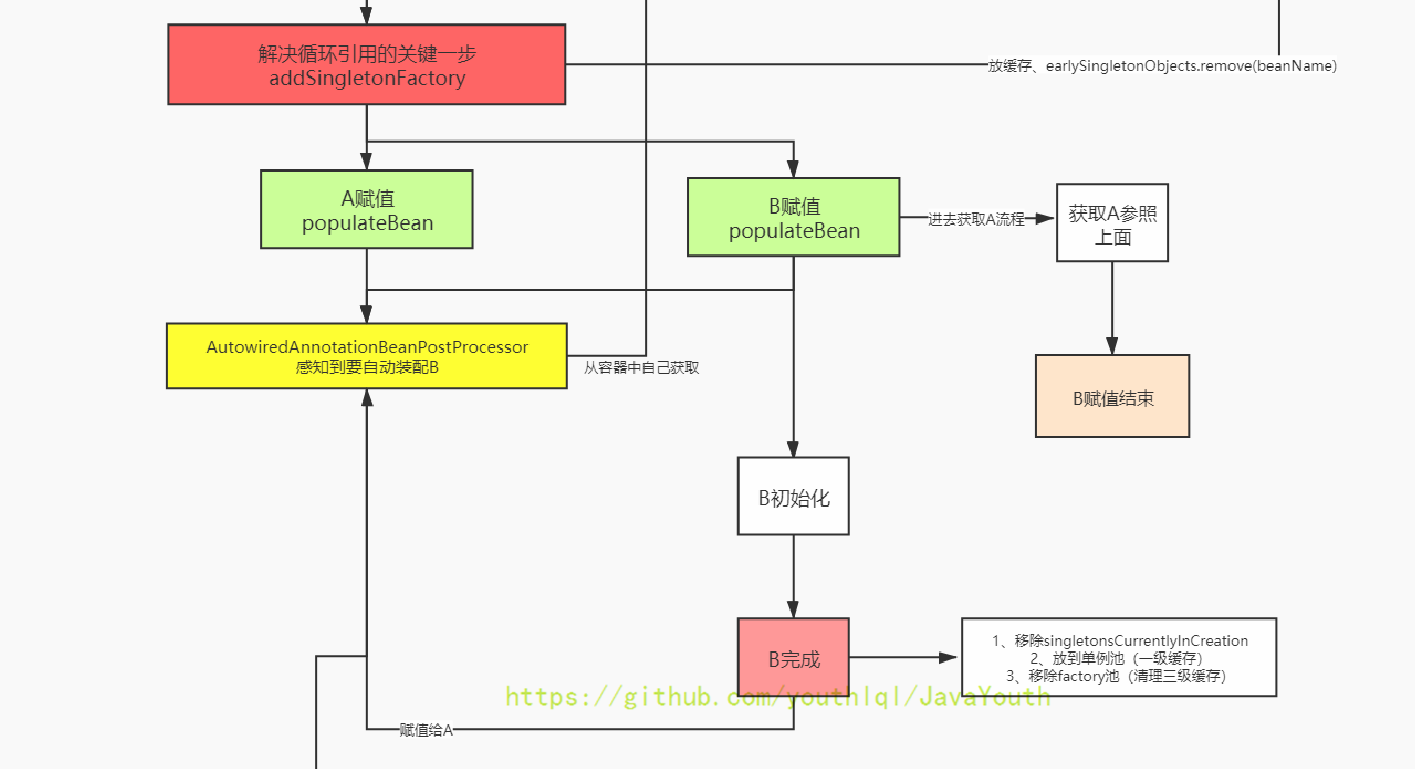
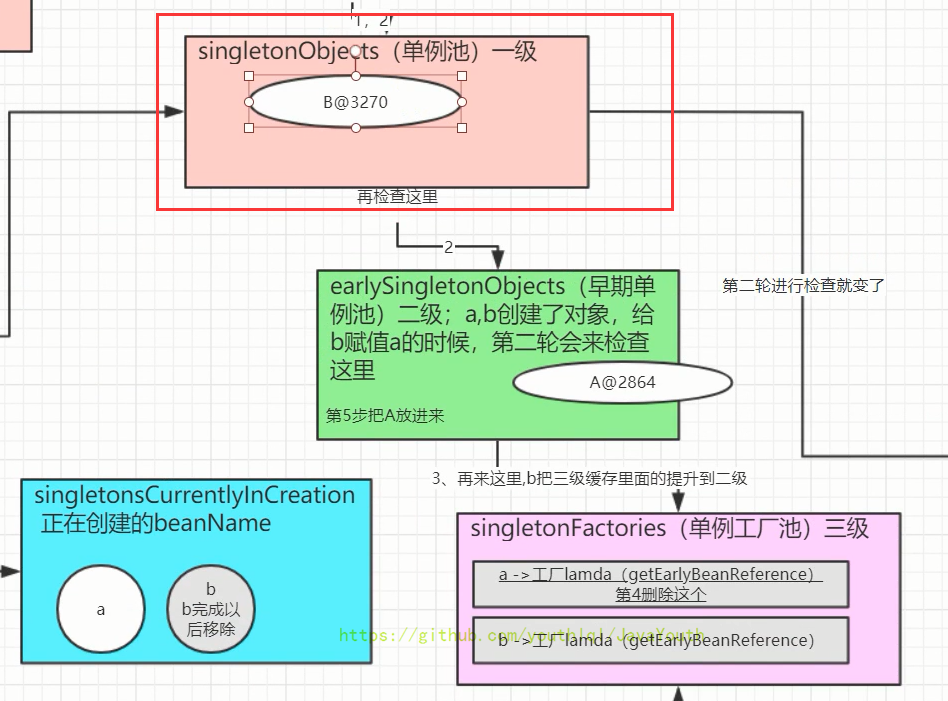 13. B全部结束之后回到A的流程,A赋值工作结束了,然后就开始A的初始化。初始化的过程中
 ```java
protected void addSingleton(String beanName, Object singletonObject) {
synchronized (this.singletonObjects) {
this.singletonObjects.put(beanName, singletonObject); //加到一级
this.singletonFactories.remove(beanName); //移除三级
this.earlySingletonObjects.remove(beanName); //移除二级
this.registeredSingletons.add(beanName);
}
}
```
```java
protected void addSingleton(String beanName, Object singletonObject) {
synchronized (this.singletonObjects) {
this.singletonObjects.put(beanName, singletonObject); //加到一级
this.singletonFactories.remove(beanName); //移除三级
this.earlySingletonObjects.remove(beanName); //移除二级
this.registeredSingletons.add(beanName);
}
}
```
 ## 全部的流程图