---
title: Spring源码系列-第3章-后置处理器和Bean生命周期
tags:
- Spring源码
categories:
- Spring
- 源码V1
keywords: Spring,框架,spring源码
description: 前面讲了Bean工厂后置处理器,这一篇开始讲Bean后置处理器
cover: 'https://npm.elemecdn.com/lql_static@latest/logo/spring.png'
abbrlink: 66c146e7
date: 2022-01-01 00:01:02
---
# 第3章-后置处理器和Bean生命周期
## 再来看一下我们的测试类
> 为了分析后面的,测试类有些许变动
### MyBeanPostProcessor
```java
@Component
public class MyBeanPostProcessor implements BeanPostProcessor {
public MyBeanPostProcessor() {
System.out.println("MyBeanPostProcessor...");
}
public Object postProcessAfterInitialization(Object bean, String beanName) throws BeansException {
System.out.println("MyBeanPostProcessor...postProcessAfterInitialization..." + bean + "==>" + beanName);
return bean;
}
public Object postProcessBeforeInitialization(Object bean, String beanName) throws BeansException {
System.out.println("MyBeanPostProcessor...postProcessBeforeInitialization..." + bean + "==>" + beanName);
return bean; // new Object();
}
}
```
### MyInstantiationAwareBeanPostProcessor
```java
@Component
public class MyInstantiationAwareBeanPostProcessor implements InstantiationAwareBeanPostProcessor {
public MyInstantiationAwareBeanPostProcessor() {
System.out.println("MyInstantiationAwareBeanPostProcessor...");
} //初始化之前进行后置处理,Spring留给我们给这个组件创建对象的回调。
public Object postProcessBeforeInstantiation(Class beanClass, String beanName) throws BeansException {
System.out.println("MyInstantiationAwareBeanPostProcessor...postProcessBeforeInstantiation=>" + beanClass + "--" + beanName); //if(class.isAssFrom(Cat.class)){return new Dog()}
return null; //如果我们自己创建了对象返回。Spring则不会帮我们创建对象,用我们自己创建的对象? 我们创建的这个对象,Spring会保存单实例?还是每次getBean都调到我们这里创建一个新的?
}
public boolean postProcessAfterInstantiation(Object bean, String beanName) throws BeansException {
System.out.println("MyInstantiationAwareBeanPostProcessor...postProcessAfterInstantiation=>" + bean + "--" + beanName); //提前改变一些Spring不管的bean里面的属性
return true; //返回false则bean的赋值全部结束
} //解析自定义注解进行属性值注入;pvs 封装了所有的属性信息。
public PropertyValues postProcessProperties(PropertyValues pvs, Object bean, String beanName)
throws BeansException {
System.out.println("MyInstantiationAwareBeanPostProcessor...postProcessProperties=>" + bean + "--" + beanName);
return null;
}
}
```
### MyMergedBeanDefinitionPostProcessor
```java
@Component
public class MyMergedBeanDefinitionPostProcessor implements MergedBeanDefinitionPostProcessor {
public MyMergedBeanDefinitionPostProcessor() {
System.out.println("MyMergedBeanDefinitionPostProcessor...");
}
@Override
public Object postProcessBeforeInitialization(Object bean, String beanName) throws BeansException {
System.out.println("MyMergedBeanDefinitionPostProcessor...postProcessBeforeInitialization...=>" + bean + "--" + beanName);
return bean; //null
}
@Override
public Object postProcessAfterInitialization(Object bean, String beanName) throws BeansException {
System.out.println("MyMergedBeanDefinitionPostProcessor...postProcessAfterInitialization..=>" + bean + "--" + beanName);
return null;
}
@Override
public void postProcessMergedBeanDefinition(RootBeanDefinition beanDefinition, Class beanType, String beanName) {
System.out.println("MyMergedBeanDefinitionPostProcessor...postProcessMergedBeanDefinition..=>" + beanName + "--" + beanType + "---" + beanDefinition);
}
@Override
public void resetBeanDefinition(String beanName) {
System.out.println("MyMergedBeanDefinitionPostProcessor...resetBeanDefinition.." + beanName);
}
}
```
### MySmartInstantiationAwareBeanPostProcessor
```java
@Component //bean进行代理增强期间进行使用
public class MySmartInstantiationAwareBeanPostProcessor implements SmartInstantiationAwareBeanPostProcessor {
public MySmartInstantiationAwareBeanPostProcessor() {
System.out.println("MySmartInstantiationAwareBeanPostProcessor...");
} //预测bean的类型,最后一次改变组件类型。
public Class predictBeanType(Class beanClass, String beanName) throws BeansException {
System.out.println("MySmartInstantiationAwareBeanPostProcessor...predictBeanType=>" + beanClass + "--" + beanName);
return null;
}
//返回我们要使用的构造器候选列表
public Constructor[] determineCandidateConstructors(Class beanClass, String beanName)
throws BeansException {
System.out.println("MySmartInstantiationAwareBeanPostProcessor...determineCandidateConstructors=>" + beanClass + "--" + beanName);
//返回一个我们指定的构造器
return null;
}
//返回早期的bean引用
public Object getEarlyBeanReference(Object bean, String beanName) throws BeansException {
System.out.println("MySmartInstantiationAwareBeanPostProcessor...getEarlyBeanReference=>" + bean + "--" + beanName);
return bean;
}
}
```
### MyBeanFactoryPostProcessor
```java
/**
* BeanFactory的后置处理器
*/
@Component
public class MyBeanFactoryPostProcessor implements BeanFactoryPostProcessor {
public MyBeanFactoryPostProcessor(){
System.out.println("MyBeanFactoryPostProcessor...");
}
@Override
public void postProcessBeanFactory(ConfigurableListableBeanFactory beanFactory) throws BeansException {
System.out.println("BeanFactoryPostProcessor....postProcessBeanFactory==>"+beanFactory);
}
}
```
### MyBeanDefinitionRegistryPostProcessor
```java
@Component
public class MyBeanDefinitionRegistryPostProcessor implements BeanDefinitionRegistryPostProcessor {
public MyBeanDefinitionRegistryPostProcessor(){
System.out.println("MyBeanDefinitionRegistryPostProcessor");
}
@Override //紧接着执行
public void postProcessBeanFactory(ConfigurableListableBeanFactory beanFactory) throws BeansException {
System.out.println("MyBeanDefinitionRegistryPostProcessor....postProcessBeanFactory...");
}
@Override //先执行的
public void postProcessBeanDefinitionRegistry(BeanDefinitionRegistry registry) throws BeansException {
System.out.println("MyBeanDefinitionRegistryPostProcessor...postProcessBeanDefinitionRegistry...");
//增强bean定义信息的注册中心,比如自己注册组件
}
}
```
### Cat
```java
@Component
public class Cat implements InitializingBean {
public Cat() {
System.out.println("cat被创建了...");
}
private String name;
@Value("${JAVA_HOME}") //自动赋值功能
public void setName(String name) {
System.out.println("cat....setName正在赋值调用....");
this.name = name;
}
//注解怎么定义这个是初始化方法?
public String getName() {
return name;
}
@Override
public void afterPropertiesSet() throws Exception {
System.out.println("CatInitializingBean..afterPropertiesSet...");
}
}
```
### beans2.xml
```java
```
### MainTest
```java
public class MainTest {
public static void main(String[] args) {
ClassPathXmlApplicationContext context = new ClassPathXmlApplicationContext("beans2.xml");
Person bean = context.getBean(Person.class);
System.out.println(bean);
}
}
```
## 继续Bean生命周期
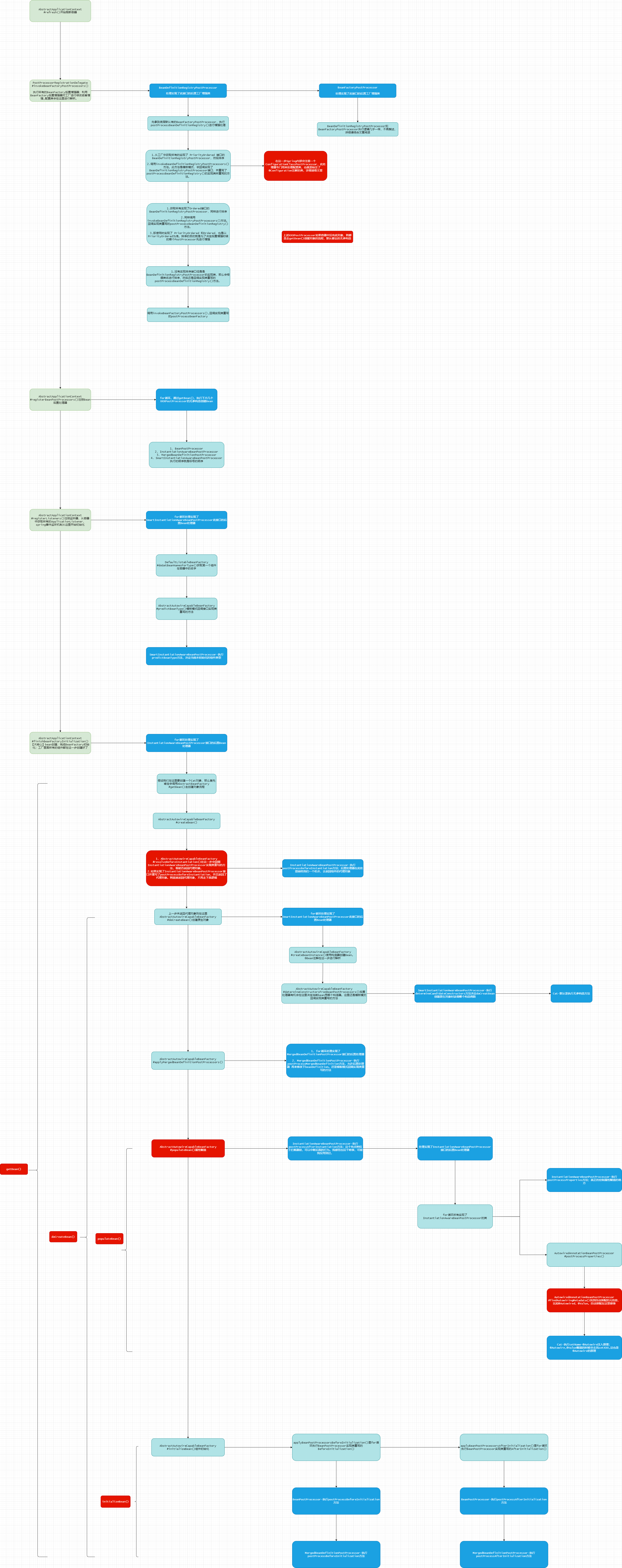
### 流程图-Bean生命周期与后置处理器
 ### BeanPostProcessor-执行无参构造
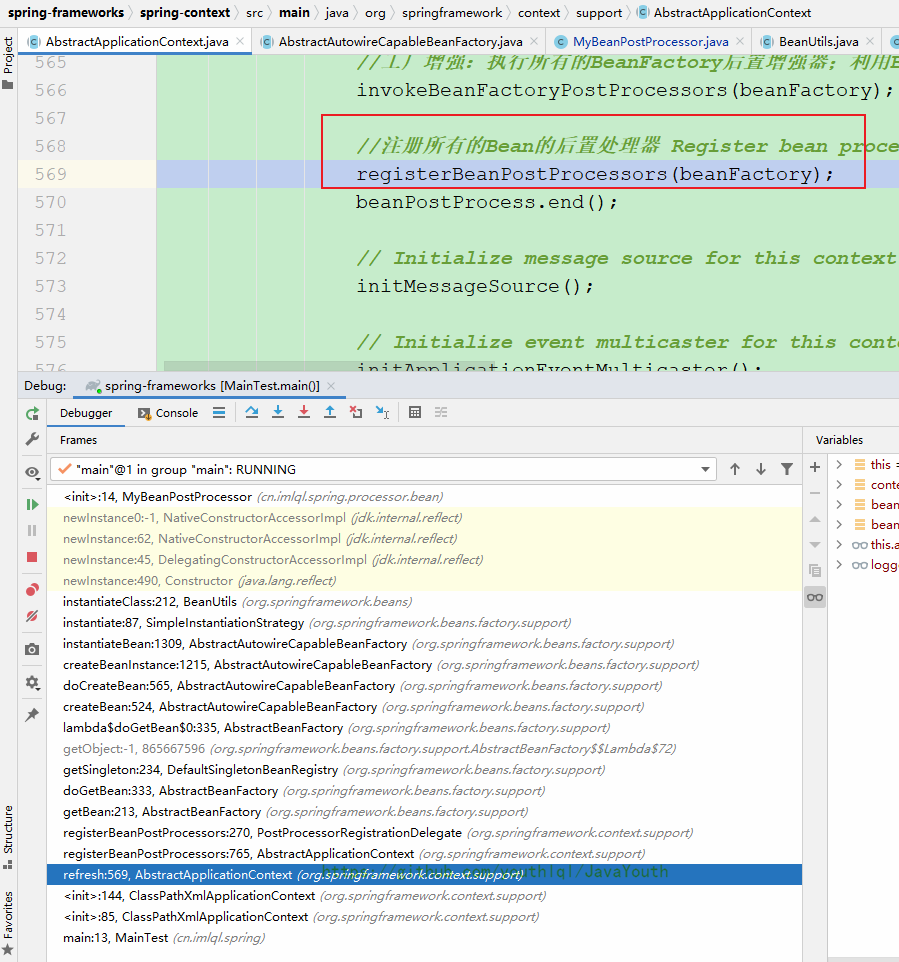
> 前面两个工厂后置处理器执行完之后,接下来就是我们的Bean后置处理器,第一个执行的就是BeanPostProcessor
#### Debug调用栈
### BeanPostProcessor-执行无参构造
> 前面两个工厂后置处理器执行完之后,接下来就是我们的Bean后置处理器,第一个执行的就是BeanPostProcessor
#### Debug调用栈
 #### AbstractApplicationContext#registerBeanPostProcessors()注册Bean后置处理器
```java
protected void registerBeanPostProcessors(ConfigurableListableBeanFactory beanFactory) {
PostProcessorRegistrationDelegate.registerBeanPostProcessors(beanFactory, this);
}
```
#### PostProcessorRegistrationDelegate#registerBeanPostProcessors()
```java
public static void registerBeanPostProcessors(
ConfigurableListableBeanFactory beanFactory, AbstractApplicationContext applicationContext) {
//获取到容器中所有的 BeanPostProcessor; Bean的后置处理器
String[] postProcessorNames = beanFactory.getBeanNamesForType(BeanPostProcessor.class, true, false);
// Register BeanPostProcessorChecker that logs an info message when
// a bean is created during BeanPostProcessor instantiation, i.e. when
// a bean is not eligible for getting processed by all BeanPostProcessors.
int beanProcessorTargetCount = beanFactory.getBeanPostProcessorCount() + 1 + postProcessorNames.length;
beanFactory.addBeanPostProcessor(new BeanPostProcessorChecker(beanFactory, beanProcessorTargetCount));
// Separate between BeanPostProcessors that implement PriorityOrdered,
// Ordered, and the rest.
List priorityOrderedPostProcessors = new ArrayList<>();
List internalPostProcessors = new ArrayList<>();
List orderedPostProcessorNames = new ArrayList<>();
List nonOrderedPostProcessorNames = new ArrayList<>();
for (String ppName : postProcessorNames) {
if (beanFactory.isTypeMatch(ppName, PriorityOrdered.class)) { //获取所有实现了 PriorityOrdered 的 BeanPostProcessor
BeanPostProcessor pp = beanFactory.getBean(ppName, BeanPostProcessor.class);
priorityOrderedPostProcessors.add(pp);
if (pp instanceof MergedBeanDefinitionPostProcessor) {
internalPostProcessors.add(pp);
}
}
else if (beanFactory.isTypeMatch(ppName, Ordered.class)) {
orderedPostProcessorNames.add(ppName);
}
else {
nonOrderedPostProcessorNames.add(ppName);
}
}
//首先,注册所有的实现了 PriorityOrdered 的 BeanPostProcessor ; First, register the BeanPostProcessors that implement PriorityOrdered.
sortPostProcessors(priorityOrderedPostProcessors, beanFactory);
registerBeanPostProcessors(beanFactory, priorityOrderedPostProcessors);
//接下来,注册所有的实现了 Ordered 的 BeanPostProcessor Next, register the BeanPostProcessors that implement Ordered.
List orderedPostProcessors = new ArrayList<>(orderedPostProcessorNames.size());
for (String ppName : orderedPostProcessorNames) {
BeanPostProcessor pp = beanFactory.getBean(ppName, BeanPostProcessor.class);
orderedPostProcessors.add(pp);
if (pp instanceof MergedBeanDefinitionPostProcessor) {
internalPostProcessors.add(pp);
}
}
sortPostProcessors(orderedPostProcessors, beanFactory);
registerBeanPostProcessors(beanFactory, orderedPostProcessors);
// 最后,注册所有普通的 BeanPostProcessor ;Now, register all regular BeanPostProcessors.
List nonOrderedPostProcessors = new ArrayList<>(nonOrderedPostProcessorNames.size());
for (String ppName : nonOrderedPostProcessorNames) {
BeanPostProcessor pp = beanFactory.getBean(ppName, BeanPostProcessor.class); //从容器中获取这个组件
nonOrderedPostProcessors.add(pp);
if (pp instanceof MergedBeanDefinitionPostProcessor) {
internalPostProcessors.add(pp);
}
}
registerBeanPostProcessors(beanFactory, nonOrderedPostProcessors);//所谓的注册其实就是保存到一个Map里面,后续用的时候可以直接拿
// Finally, re-register all internal BeanPostProcessors.
sortPostProcessors(internalPostProcessors, beanFactory);
registerBeanPostProcessors(beanFactory, internalPostProcessors);
// Re-register post-processor for detecting inner beans as ApplicationListeners,
// moving it to the end of the processor chain (for picking up proxies etc).
beanFactory.addBeanPostProcessor(new ApplicationListenerDetector(applicationContext));
}
```
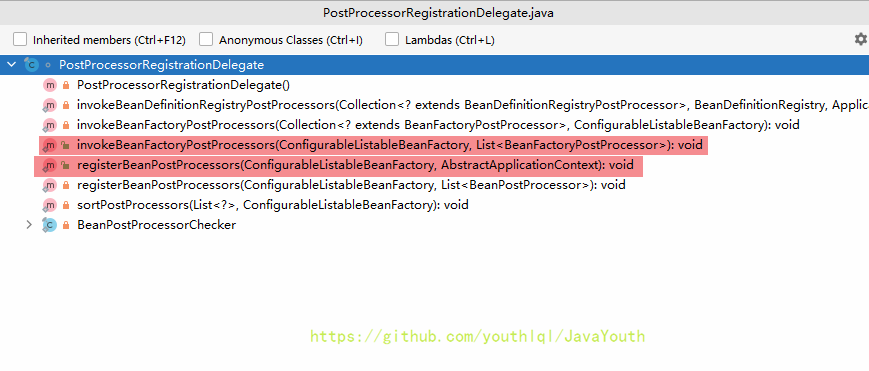
- Bean工厂后置处理器调用的是`invokeBeanFactoryPostProcessors(ConfigurableListableBeanFactory , List )`
- Bean后置处理器调用的是`registerBeanPostProcessors(ConfigurableListableBeanFactory , AbstractApplicationContext )`
#### AbstractApplicationContext#registerBeanPostProcessors()注册Bean后置处理器
```java
protected void registerBeanPostProcessors(ConfigurableListableBeanFactory beanFactory) {
PostProcessorRegistrationDelegate.registerBeanPostProcessors(beanFactory, this);
}
```
#### PostProcessorRegistrationDelegate#registerBeanPostProcessors()
```java
public static void registerBeanPostProcessors(
ConfigurableListableBeanFactory beanFactory, AbstractApplicationContext applicationContext) {
//获取到容器中所有的 BeanPostProcessor; Bean的后置处理器
String[] postProcessorNames = beanFactory.getBeanNamesForType(BeanPostProcessor.class, true, false);
// Register BeanPostProcessorChecker that logs an info message when
// a bean is created during BeanPostProcessor instantiation, i.e. when
// a bean is not eligible for getting processed by all BeanPostProcessors.
int beanProcessorTargetCount = beanFactory.getBeanPostProcessorCount() + 1 + postProcessorNames.length;
beanFactory.addBeanPostProcessor(new BeanPostProcessorChecker(beanFactory, beanProcessorTargetCount));
// Separate between BeanPostProcessors that implement PriorityOrdered,
// Ordered, and the rest.
List priorityOrderedPostProcessors = new ArrayList<>();
List internalPostProcessors = new ArrayList<>();
List orderedPostProcessorNames = new ArrayList<>();
List nonOrderedPostProcessorNames = new ArrayList<>();
for (String ppName : postProcessorNames) {
if (beanFactory.isTypeMatch(ppName, PriorityOrdered.class)) { //获取所有实现了 PriorityOrdered 的 BeanPostProcessor
BeanPostProcessor pp = beanFactory.getBean(ppName, BeanPostProcessor.class);
priorityOrderedPostProcessors.add(pp);
if (pp instanceof MergedBeanDefinitionPostProcessor) {
internalPostProcessors.add(pp);
}
}
else if (beanFactory.isTypeMatch(ppName, Ordered.class)) {
orderedPostProcessorNames.add(ppName);
}
else {
nonOrderedPostProcessorNames.add(ppName);
}
}
//首先,注册所有的实现了 PriorityOrdered 的 BeanPostProcessor ; First, register the BeanPostProcessors that implement PriorityOrdered.
sortPostProcessors(priorityOrderedPostProcessors, beanFactory);
registerBeanPostProcessors(beanFactory, priorityOrderedPostProcessors);
//接下来,注册所有的实现了 Ordered 的 BeanPostProcessor Next, register the BeanPostProcessors that implement Ordered.
List orderedPostProcessors = new ArrayList<>(orderedPostProcessorNames.size());
for (String ppName : orderedPostProcessorNames) {
BeanPostProcessor pp = beanFactory.getBean(ppName, BeanPostProcessor.class);
orderedPostProcessors.add(pp);
if (pp instanceof MergedBeanDefinitionPostProcessor) {
internalPostProcessors.add(pp);
}
}
sortPostProcessors(orderedPostProcessors, beanFactory);
registerBeanPostProcessors(beanFactory, orderedPostProcessors);
// 最后,注册所有普通的 BeanPostProcessor ;Now, register all regular BeanPostProcessors.
List nonOrderedPostProcessors = new ArrayList<>(nonOrderedPostProcessorNames.size());
for (String ppName : nonOrderedPostProcessorNames) {
BeanPostProcessor pp = beanFactory.getBean(ppName, BeanPostProcessor.class); //从容器中获取这个组件
nonOrderedPostProcessors.add(pp);
if (pp instanceof MergedBeanDefinitionPostProcessor) {
internalPostProcessors.add(pp);
}
}
registerBeanPostProcessors(beanFactory, nonOrderedPostProcessors);//所谓的注册其实就是保存到一个Map里面,后续用的时候可以直接拿
// Finally, re-register all internal BeanPostProcessors.
sortPostProcessors(internalPostProcessors, beanFactory);
registerBeanPostProcessors(beanFactory, internalPostProcessors);
// Re-register post-processor for detecting inner beans as ApplicationListeners,
// moving it to the end of the processor chain (for picking up proxies etc).
beanFactory.addBeanPostProcessor(new ApplicationListenerDetector(applicationContext));
}
```
- Bean工厂后置处理器调用的是`invokeBeanFactoryPostProcessors(ConfigurableListableBeanFactory , List )`
- Bean后置处理器调用的是`registerBeanPostProcessors(ConfigurableListableBeanFactory , AbstractApplicationContext )`
 ### InstantiationAwareBeanPostProcessor-执行无参构造
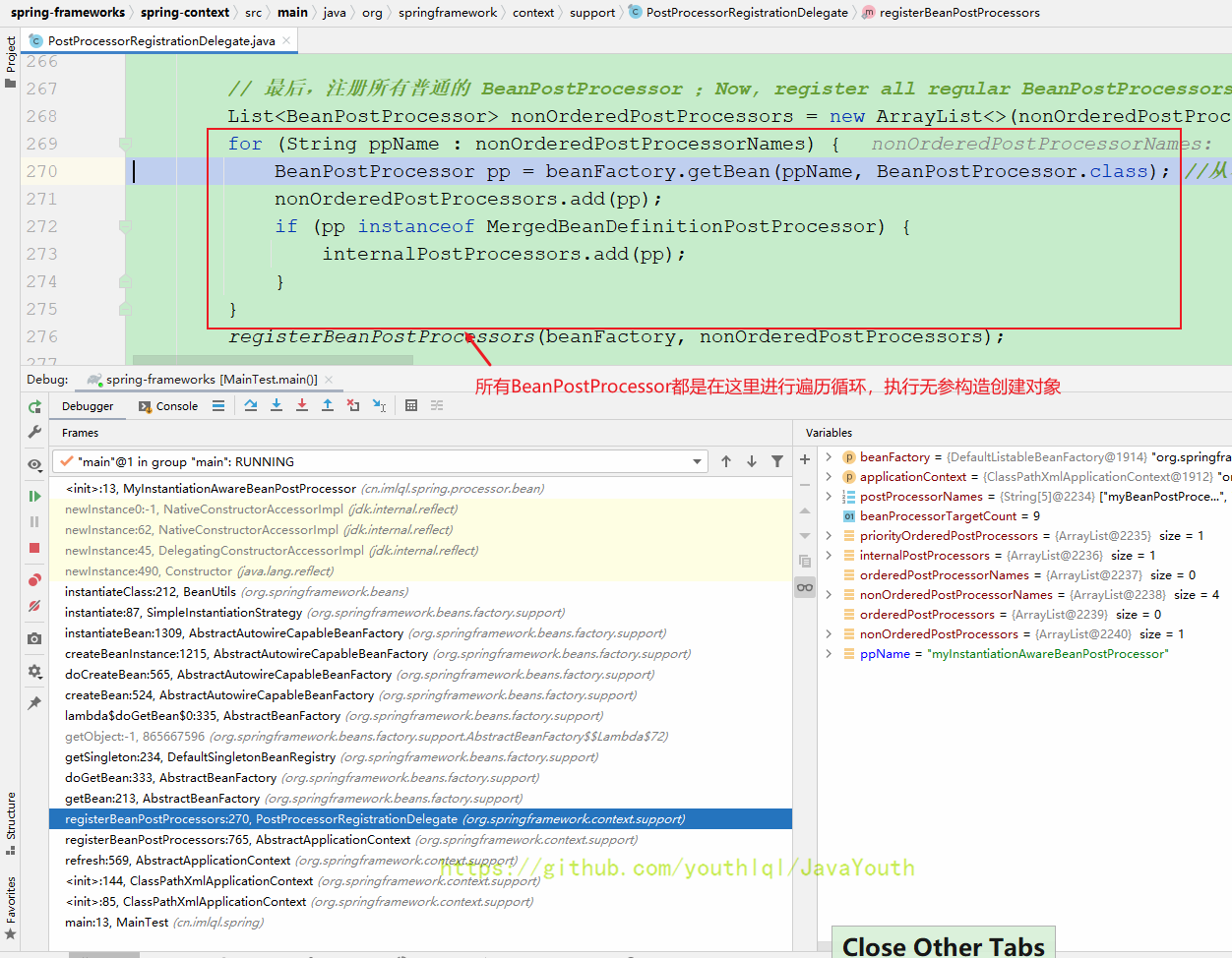
> 1. BeanPostProcessor执行顺序和BeanFactoryPostProcessor有点不一样
> 2. BeanFactoryPostProcessor是先执行完每一个的无参构造和实现的几个方法,再去执行下一个BeanFactoryPostProcessor
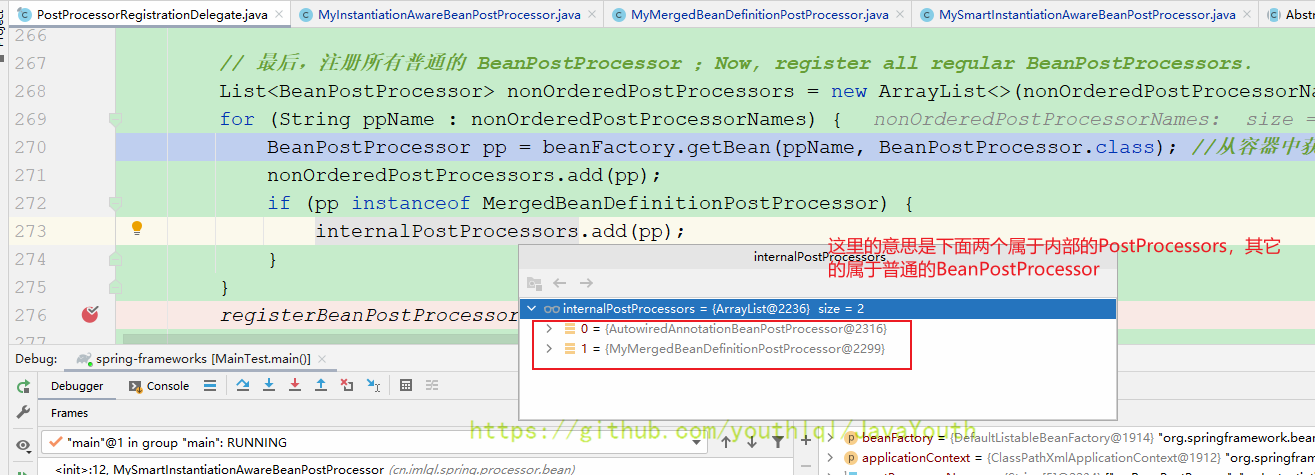
> 3. BeanPostProcessor是先执行所有BeanPostProcessor的无参构造,再执行所有BeanPostProcessor实现的方法。
### InstantiationAwareBeanPostProcessor-执行无参构造
> 1. BeanPostProcessor执行顺序和BeanFactoryPostProcessor有点不一样
> 2. BeanFactoryPostProcessor是先执行完每一个的无参构造和实现的几个方法,再去执行下一个BeanFactoryPostProcessor
> 3. BeanPostProcessor是先执行所有BeanPostProcessor的无参构造,再执行所有BeanPostProcessor实现的方法。
 ### MergedBeanDefinitionPostProcessor-执行无参构造
同上
### SmartInstantiationAwareBeanPostProcessor-执行无参构造
同上
### MergedBeanDefinitionPostProcessor-执行无参构造
同上
### SmartInstantiationAwareBeanPostProcessor-执行无参构造
同上
 ### SmartInstantiationAwareBeanPostProcessor-执行predictBeanType方法
#### Debug调用栈
### SmartInstantiationAwareBeanPostProcessor-执行predictBeanType方法
#### Debug调用栈
 #### AbstractApplicationContext#refresh()
```java
@Override //容器刷新的十二大步。
public void refresh() throws BeansException, IllegalStateException {
synchronized (this.startupShutdownMonitor) {
StartupStep contextRefresh = this.applicationStartup.start("spring.context.refresh");
// Prepare this context for refreshing.
prepareRefresh();
// Tell the subclass to refresh the internal bean factory.
// 工厂创建:BeanFactory第一次开始创建的时候,有xml解析逻辑。
ConfigurableListableBeanFactory beanFactory = obtainFreshBeanFactory();
// Prepare the bean factory for use in this context.
prepareBeanFactory(beanFactory);
try {
// Allows post-processing of the bean factory in context subclasses.
postProcessBeanFactory(beanFactory);
StartupStep beanPostProcess = this.applicationStartup.start("spring.context.beans.post-process");
//工厂增强:执行所有的BeanFactory后置增强器;利用BeanFactory后置增强器对工厂进行修改或者增强,配置类会在这里进行解析。 Invoke factory processors registered as beans in the context.
invokeBeanFactoryPostProcessors(beanFactory);
//注册所有的Bean的后置处理器 Register bean processors that intercept bean creation.
registerBeanPostProcessors(beanFactory);
beanPostProcess.end();
// Initialize message source for this context.
initMessageSource();
// Initialize event multicaster for this context.
initApplicationEventMulticaster();
// Initialize other special beans in specific context subclasses.
onRefresh();
//注册监听器,从容器中获取所有的ApplicationListener; Check for listener beans and register them.
registerListeners();
// Instantiate all remaining (non-lazy-init) singletons.
//bean创建;完成 BeanFactory 初始化。(工厂里面所有的组件都好了)
finishBeanFactoryInitialization(beanFactory);
// Last step: publish corresponding event.
finishRefresh();
}
catch (BeansException ex) {
if (logger.isWarnEnabled()) {
logger.warn("Exception encountered during context initialization - " +
"cancelling refresh attempt: " + ex);
}
// Destroy already created singletons to avoid dangling resources.
destroyBeans();
// Reset 'active' flag.
cancelRefresh(ex);
// Propagate exception to caller.
throw ex;
}
finally {
// Reset common introspection caches in Spring's core, since we
// might not ever need metadata for singleton beans anymore...
resetCommonCaches();
contextRefresh.end();
}
}
}
protected void registerListeners() {
// Register statically specified listeners first.
for (ApplicationListener listener : getApplicationListeners()) {
getApplicationEventMulticaster().addApplicationListener(listener);
}
// Do not initialize FactoryBeans here: We need to leave all regular beans
// uninitialized to let post-processors apply to them! 获取ApplicationListener在ioc容器中注册的bean的名字
String[] listenerBeanNames = getBeanNamesForType(ApplicationListener.class, true, false);
for (String listenerBeanName : listenerBeanNames) {
getApplicationEventMulticaster().addApplicationListenerBean(listenerBeanName); //获取所有的容器中的监听器,并保存他们的名字
}
// Publish early application events now that we finally have a multicaster...
Set earlyEventsToProcess = this.earlyApplicationEvents;
this.earlyApplicationEvents = null;
if (!CollectionUtils.isEmpty(earlyEventsToProcess)) {
for (ApplicationEvent earlyEvent : earlyEventsToProcess) {
getApplicationEventMulticaster().multicastEvent(earlyEvent);
}
}
}
```
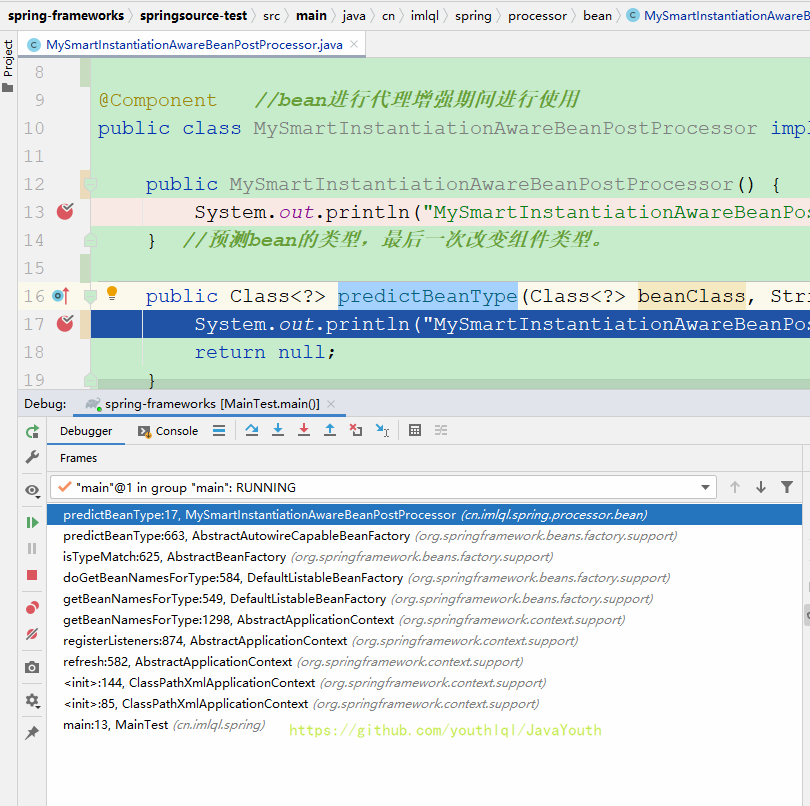
在调用registerListeners()的时候,竟然进入到了我们的后置处理器逻辑,我们接着往后看
#### DefaultListableBeanFactory#doGetBeanNamesForType()获取某一个组件在容器中的名字
调过一些不重要的调用,逻辑到了这里
```java
//获取某一个组件在容器中的名字。
private String[] doGetBeanNamesForType(ResolvableType type, boolean includeNonSingletons, boolean allowEagerInit) {
List result = new ArrayList<>();
// Check all bean definitions. 因为Spring没有直接保存class--bean名字的对应信息,只能遍历所有的beanname,拿出他们beanname的定义信息,再看是否我指定的类型。
for (String beanName : this.beanDefinitionNames) {
// Only consider bean as eligible if the bean name is not defined as alias for some other bean.
if (!isAlias(beanName)) { //判断是否别名
try {
RootBeanDefinition mbd = getMergedLocalBeanDefinition(beanName);
// Only check bean definition if it is complete.
if (!mbd.isAbstract() && (allowEagerInit ||
(mbd.hasBeanClass() || !mbd.isLazyInit() || isAllowEagerClassLoading()) &&
!requiresEagerInitForType(mbd.getFactoryBeanName()))) {
boolean isFactoryBean = isFactoryBean(beanName, mbd); //是否FactoryBean
BeanDefinitionHolder dbd = mbd.getDecoratedDefinition();
boolean matchFound = false;
boolean allowFactoryBeanInit = (allowEagerInit || containsSingleton(beanName));
boolean isNonLazyDecorated = (dbd != null && !mbd.isLazyInit());
if (!isFactoryBean) {
if (includeNonSingletons || isSingleton(beanName, mbd, dbd)) {
matchFound = isTypeMatch(beanName, type, allowFactoryBeanInit); //是否类型匹配?
}
}
else {
if (includeNonSingletons || isNonLazyDecorated ||
(allowFactoryBeanInit && isSingleton(beanName, mbd, dbd))) {
matchFound = isTypeMatch(beanName, type, allowFactoryBeanInit);
}
if (!matchFound) {
// In case of FactoryBean, try to match FactoryBean instance itself next.
beanName = FACTORY_BEAN_PREFIX + beanName;
matchFound = isTypeMatch(beanName, type, allowFactoryBeanInit);
}
}
if (matchFound) {
result.add(beanName);
}
}
}
// ......
}
}
// ......
return StringUtils.toStringArray(result);
}
```
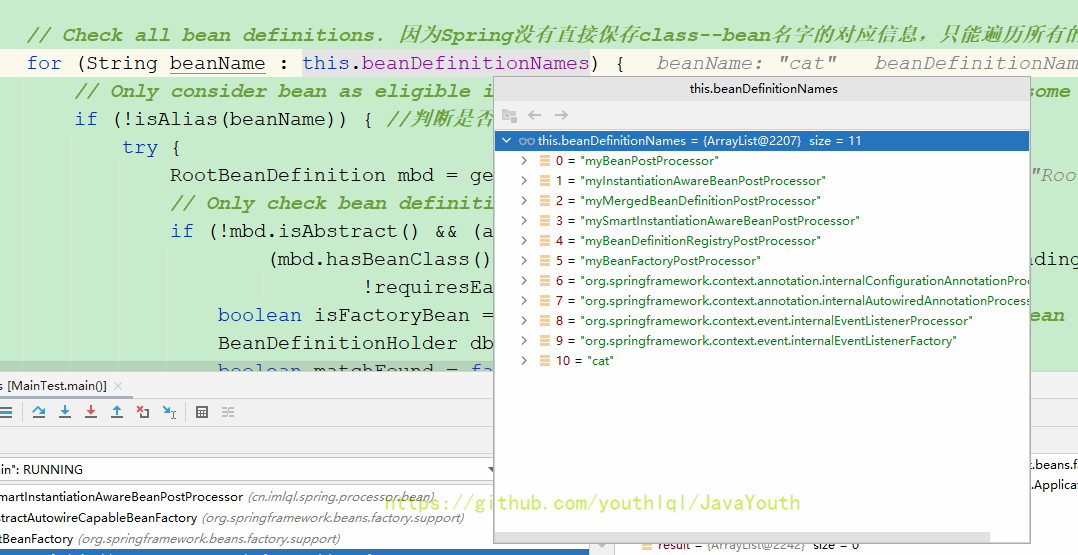
1. 下面是容器中现在有的bean定义信息,但是这些bean不一定都创建好了。
2. Spring在这里是想要按照类型去容器中去找组件,在这里就是想找ApplicationListener.class类型的组件。但是Spring中只存储了BeanName=>BeanType的对应关系(BeanDefinitions),没有存BeanType=>BeanName的对应关系。
1. 所以在这里只能遍历循环beanDefinitionNames
2. 通过beanName再去BeanDefinitions拿beanType
3. 判断是不是想要的类型。
3. 这里有没有优化空间,再存一个BeanType=>BeanName的对应关系?但是这样的关系是一对多的,同一个BeanType下可能有多个beanName,Spring可能是考虑到空间成本,没有这样弄。
#### AbstractApplicationContext#refresh()
```java
@Override //容器刷新的十二大步。
public void refresh() throws BeansException, IllegalStateException {
synchronized (this.startupShutdownMonitor) {
StartupStep contextRefresh = this.applicationStartup.start("spring.context.refresh");
// Prepare this context for refreshing.
prepareRefresh();
// Tell the subclass to refresh the internal bean factory.
// 工厂创建:BeanFactory第一次开始创建的时候,有xml解析逻辑。
ConfigurableListableBeanFactory beanFactory = obtainFreshBeanFactory();
// Prepare the bean factory for use in this context.
prepareBeanFactory(beanFactory);
try {
// Allows post-processing of the bean factory in context subclasses.
postProcessBeanFactory(beanFactory);
StartupStep beanPostProcess = this.applicationStartup.start("spring.context.beans.post-process");
//工厂增强:执行所有的BeanFactory后置增强器;利用BeanFactory后置增强器对工厂进行修改或者增强,配置类会在这里进行解析。 Invoke factory processors registered as beans in the context.
invokeBeanFactoryPostProcessors(beanFactory);
//注册所有的Bean的后置处理器 Register bean processors that intercept bean creation.
registerBeanPostProcessors(beanFactory);
beanPostProcess.end();
// Initialize message source for this context.
initMessageSource();
// Initialize event multicaster for this context.
initApplicationEventMulticaster();
// Initialize other special beans in specific context subclasses.
onRefresh();
//注册监听器,从容器中获取所有的ApplicationListener; Check for listener beans and register them.
registerListeners();
// Instantiate all remaining (non-lazy-init) singletons.
//bean创建;完成 BeanFactory 初始化。(工厂里面所有的组件都好了)
finishBeanFactoryInitialization(beanFactory);
// Last step: publish corresponding event.
finishRefresh();
}
catch (BeansException ex) {
if (logger.isWarnEnabled()) {
logger.warn("Exception encountered during context initialization - " +
"cancelling refresh attempt: " + ex);
}
// Destroy already created singletons to avoid dangling resources.
destroyBeans();
// Reset 'active' flag.
cancelRefresh(ex);
// Propagate exception to caller.
throw ex;
}
finally {
// Reset common introspection caches in Spring's core, since we
// might not ever need metadata for singleton beans anymore...
resetCommonCaches();
contextRefresh.end();
}
}
}
protected void registerListeners() {
// Register statically specified listeners first.
for (ApplicationListener listener : getApplicationListeners()) {
getApplicationEventMulticaster().addApplicationListener(listener);
}
// Do not initialize FactoryBeans here: We need to leave all regular beans
// uninitialized to let post-processors apply to them! 获取ApplicationListener在ioc容器中注册的bean的名字
String[] listenerBeanNames = getBeanNamesForType(ApplicationListener.class, true, false);
for (String listenerBeanName : listenerBeanNames) {
getApplicationEventMulticaster().addApplicationListenerBean(listenerBeanName); //获取所有的容器中的监听器,并保存他们的名字
}
// Publish early application events now that we finally have a multicaster...
Set earlyEventsToProcess = this.earlyApplicationEvents;
this.earlyApplicationEvents = null;
if (!CollectionUtils.isEmpty(earlyEventsToProcess)) {
for (ApplicationEvent earlyEvent : earlyEventsToProcess) {
getApplicationEventMulticaster().multicastEvent(earlyEvent);
}
}
}
```
在调用registerListeners()的时候,竟然进入到了我们的后置处理器逻辑,我们接着往后看
#### DefaultListableBeanFactory#doGetBeanNamesForType()获取某一个组件在容器中的名字
调过一些不重要的调用,逻辑到了这里
```java
//获取某一个组件在容器中的名字。
private String[] doGetBeanNamesForType(ResolvableType type, boolean includeNonSingletons, boolean allowEagerInit) {
List result = new ArrayList<>();
// Check all bean definitions. 因为Spring没有直接保存class--bean名字的对应信息,只能遍历所有的beanname,拿出他们beanname的定义信息,再看是否我指定的类型。
for (String beanName : this.beanDefinitionNames) {
// Only consider bean as eligible if the bean name is not defined as alias for some other bean.
if (!isAlias(beanName)) { //判断是否别名
try {
RootBeanDefinition mbd = getMergedLocalBeanDefinition(beanName);
// Only check bean definition if it is complete.
if (!mbd.isAbstract() && (allowEagerInit ||
(mbd.hasBeanClass() || !mbd.isLazyInit() || isAllowEagerClassLoading()) &&
!requiresEagerInitForType(mbd.getFactoryBeanName()))) {
boolean isFactoryBean = isFactoryBean(beanName, mbd); //是否FactoryBean
BeanDefinitionHolder dbd = mbd.getDecoratedDefinition();
boolean matchFound = false;
boolean allowFactoryBeanInit = (allowEagerInit || containsSingleton(beanName));
boolean isNonLazyDecorated = (dbd != null && !mbd.isLazyInit());
if (!isFactoryBean) {
if (includeNonSingletons || isSingleton(beanName, mbd, dbd)) {
matchFound = isTypeMatch(beanName, type, allowFactoryBeanInit); //是否类型匹配?
}
}
else {
if (includeNonSingletons || isNonLazyDecorated ||
(allowFactoryBeanInit && isSingleton(beanName, mbd, dbd))) {
matchFound = isTypeMatch(beanName, type, allowFactoryBeanInit);
}
if (!matchFound) {
// In case of FactoryBean, try to match FactoryBean instance itself next.
beanName = FACTORY_BEAN_PREFIX + beanName;
matchFound = isTypeMatch(beanName, type, allowFactoryBeanInit);
}
}
if (matchFound) {
result.add(beanName);
}
}
}
// ......
}
}
// ......
return StringUtils.toStringArray(result);
}
```
1. 下面是容器中现在有的bean定义信息,但是这些bean不一定都创建好了。
2. Spring在这里是想要按照类型去容器中去找组件,在这里就是想找ApplicationListener.class类型的组件。但是Spring中只存储了BeanName=>BeanType的对应关系(BeanDefinitions),没有存BeanType=>BeanName的对应关系。
1. 所以在这里只能遍历循环beanDefinitionNames
2. 通过beanName再去BeanDefinitions拿beanType
3. 判断是不是想要的类型。
3. 这里有没有优化空间,再存一个BeanType=>BeanName的对应关系?但是这样的关系是一对多的,同一个BeanType下可能有多个beanName,Spring可能是考虑到空间成本,没有这样弄。
 #### AbstractBeanFactory#isTypeMatch()
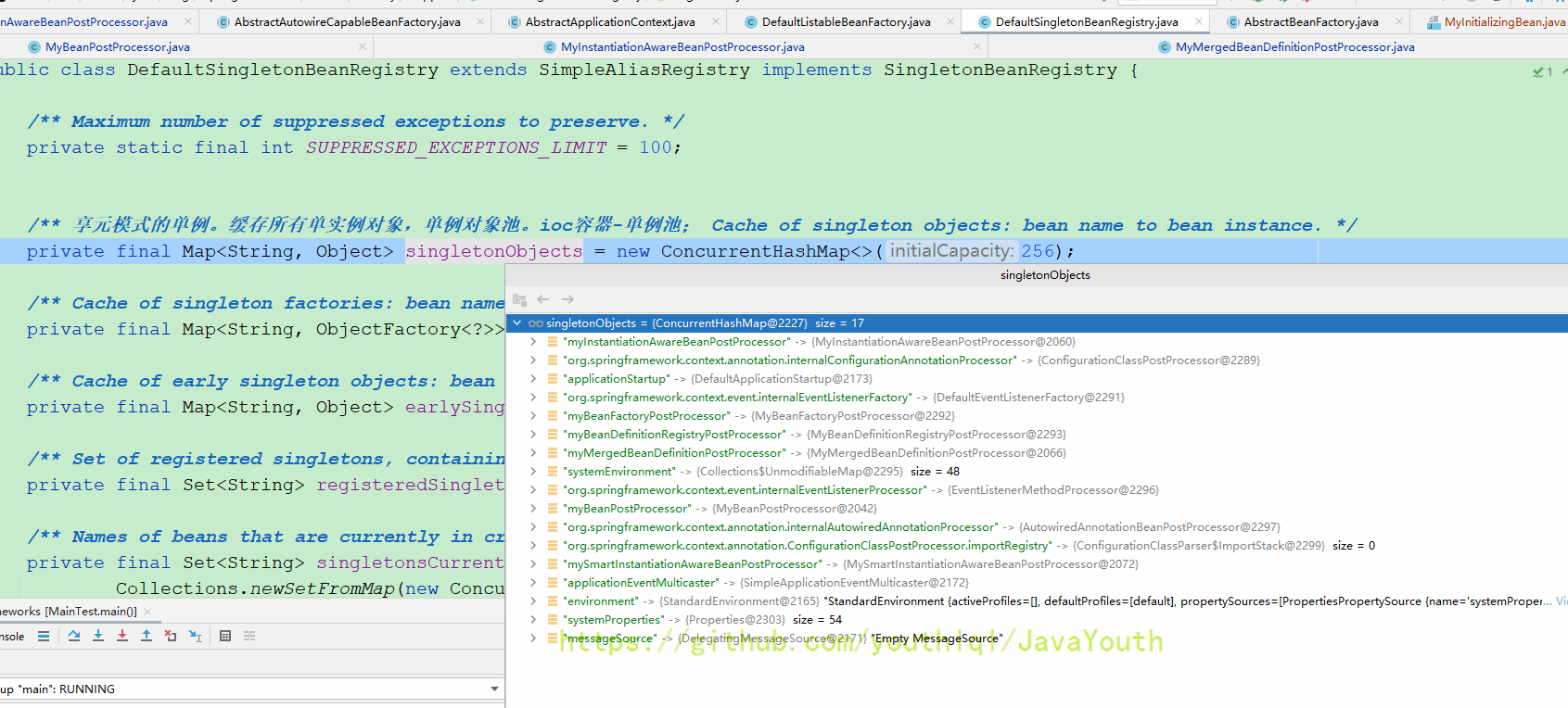
1. 有一个小细节,在debug的时候我们发现这里,只有Cat类进入到了后续判断,为什么上面的其它9个类没有进入后续逻辑呢?
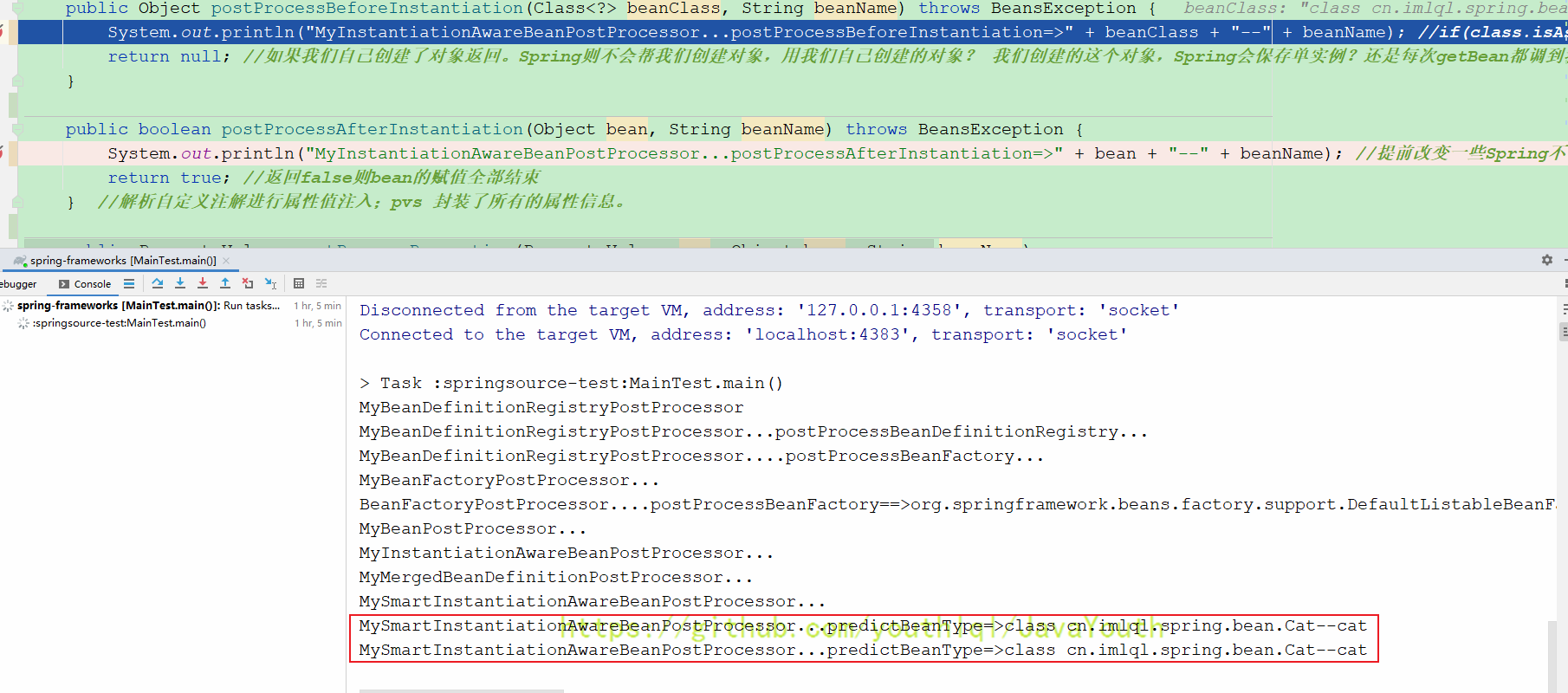
这里是因为其它9个对象都已经在之前创建好了对象,只有Cat还没有创建对象。Spring在这里给我们一个机会,在对象创建之前,我们可以最后一次决定Cat的类型。什么意思?往后看
2. 我们来看看此时单例池里有哪些对象
#### AbstractBeanFactory#isTypeMatch()
1. 有一个小细节,在debug的时候我们发现这里,只有Cat类进入到了后续判断,为什么上面的其它9个类没有进入后续逻辑呢?
这里是因为其它9个对象都已经在之前创建好了对象,只有Cat还没有创建对象。Spring在这里给我们一个机会,在对象创建之前,我们可以最后一次决定Cat的类型。什么意思?往后看
2. 我们来看看此时单例池里有哪些对象
 ```java
protected boolean isTypeMatch(String name, ResolvableType typeToMatch, boolean allowFactoryBeanInit)
throws NoSuchBeanDefinitionException {
String beanName = transformedBeanName(name);
boolean isFactoryDereference = BeanFactoryUtils.isFactoryDereference(name);
// 检查是否已经有这个beanName的单例对象,有了直接用对象的Class,没有可以最后一次决定这个组件的类型;SmartInstantiationAwareBeanPostProcessor.predictBeanType() Check manually registered singletons.
Object beanInstance = getSingleton(beanName, false);
if (beanInstance != null && beanInstance.getClass() != NullBean.class) {
if (beanInstance instanceof FactoryBean) {
if (!isFactoryDereference) {
Class type = getTypeForFactoryBean((FactoryBean) beanInstance);
return (type != null && typeToMatch.isAssignableFrom(type));
}
else {
return typeToMatch.isInstance(beanInstance);
}
}
else if (!isFactoryDereference) {
if (typeToMatch.isInstance(beanInstance)) {
// Direct match for exposed instance?
return true;
}
else if (typeToMatch.hasGenerics() && containsBeanDefinition(beanName)) {
// ......
return (resolvableType != null && typeToMatch.isAssignableFrom(resolvableType));
}
}
return false;
}
else if (containsSingleton(beanName) && !containsBeanDefinition(beanName)) {
// null instance registered
return false;
}
// No singleton instance found -> check bean definition.
BeanFactory parentBeanFactory = getParentBeanFactory();
if (parentBeanFactory != null && !containsBeanDefinition(beanName)) {
// No bean definition found in this factory -> delegate to parent.
return parentBeanFactory.isTypeMatch(originalBeanName(name), typeToMatch);
}
// Retrieve corresponding bean definition.
RootBeanDefinition mbd = getMergedLocalBeanDefinition(beanName);
BeanDefinitionHolder dbd = mbd.getDecoratedDefinition();
// Setup the types that we want to match against
Class classToMatch = typeToMatch.resolve();
if (classToMatch == null) {
classToMatch = FactoryBean.class;
}
Class[] typesToMatch = (FactoryBean.class == classToMatch ?
new Class[] {classToMatch} : new Class[] {FactoryBean.class, classToMatch});
// Attempt to predict the bean type
Class predictedType = null;
if (!isFactoryDereference && dbd != null && isFactoryBean(beanName, mbd)) {
// ...
}
// 通过后置处理器,可以返回自定义的类型 If we couldn't use the target type, try regular prediction.
if (predictedType == null) {
predictedType = predictBeanType(beanName, mbd, typesToMatch);
if (predictedType == null) {
return false;
}
}
//......
// If we don't have a bean type, fallback to the predicted type
return typeToMatch.isAssignableFrom(predictedType);
}
```
预测BeanType是什么意思呢?因为每个组件都会经过我们自定义的方法,假设你现在有个Cat类,你可以在这里写个if判断。你可以让猫变成狗,有点类似于指鹿为马
```java
public Class predictBeanType(Class beanClass, String beanName) throws BeansException {
System.out.println("MySmartInstantiationAwareBeanPostProcessor...predictBeanType=>" + beanClass + "--" + beanName);
if(beanClass == Cat.class){
return Dog.class;
}
return null;
}
```
#### AbstractAutowireCapableBeanFactory#predictBeanType()
```java
protected Class predictBeanType(String beanName, RootBeanDefinition mbd, Class... typesToMatch) {
Class targetType = determineTargetType(beanName, mbd, typesToMatch);
// Apply SmartInstantiationAwareBeanPostProcessors to predict the
// eventual type after a before-instantiation shortcut.
if (targetType != null && !mbd.isSynthetic() && hasInstantiationAwareBeanPostProcessors()) {
boolean matchingOnlyFactoryBean = typesToMatch.length == 1 && typesToMatch[0] == FactoryBean.class;
for (SmartInstantiationAwareBeanPostProcessor bp : getBeanPostProcessorCache().smartInstantiationAware) {
// 在这里调用我们自定义的predictBeanType,也就是MySmartInstantiationAwareBeanPostProcessor#predictBeanType
Class predicted = bp.predictBeanType(targetType, beanName);//还是可以理解为模板模式
if (predicted != null &&
(!matchingOnlyFactoryBean || FactoryBean.class.isAssignableFrom(predicted))) {
return predicted;
}
}
}
return targetType;
}
```
#### 此方法能做什么?
1. SmartInstantiationAwareBeanPostProcessor起名为**智能实例化感知后置处理器**,smart也是聪明的意思,表示这是一个聪明的后置处理器
2. 之所以这样起名,意思是我们可以实现这个接口然后实现它的方法,就可以告诉Spring:我们要使用的构造器候选列表。我们期望它是什么BeanType,甚至可以返回早期的bean引用(后面说)
3. 那应用场景什么呢?
1. 当一个组件需要代理对象的时候,你如果返回原来的BeanType肯定是不对的,这时候这个功能就起作用了
2. 还有我们可以在这里强制Spring全部使用有参构造器创建我们自己的Bean
3. bean进行代理增强期间这个接口用的比较多
4. 在Spring中只要调用了`doGetBeanNamesForType方法`或者`getBeanNamesForType方法`,就一定会经过SmartInstantiationAwareBeanPostProcessor的处理
在此方法里为什么Cat会进来两次呢?往后面看
```java
protected boolean isTypeMatch(String name, ResolvableType typeToMatch, boolean allowFactoryBeanInit)
throws NoSuchBeanDefinitionException {
String beanName = transformedBeanName(name);
boolean isFactoryDereference = BeanFactoryUtils.isFactoryDereference(name);
// 检查是否已经有这个beanName的单例对象,有了直接用对象的Class,没有可以最后一次决定这个组件的类型;SmartInstantiationAwareBeanPostProcessor.predictBeanType() Check manually registered singletons.
Object beanInstance = getSingleton(beanName, false);
if (beanInstance != null && beanInstance.getClass() != NullBean.class) {
if (beanInstance instanceof FactoryBean) {
if (!isFactoryDereference) {
Class type = getTypeForFactoryBean((FactoryBean) beanInstance);
return (type != null && typeToMatch.isAssignableFrom(type));
}
else {
return typeToMatch.isInstance(beanInstance);
}
}
else if (!isFactoryDereference) {
if (typeToMatch.isInstance(beanInstance)) {
// Direct match for exposed instance?
return true;
}
else if (typeToMatch.hasGenerics() && containsBeanDefinition(beanName)) {
// ......
return (resolvableType != null && typeToMatch.isAssignableFrom(resolvableType));
}
}
return false;
}
else if (containsSingleton(beanName) && !containsBeanDefinition(beanName)) {
// null instance registered
return false;
}
// No singleton instance found -> check bean definition.
BeanFactory parentBeanFactory = getParentBeanFactory();
if (parentBeanFactory != null && !containsBeanDefinition(beanName)) {
// No bean definition found in this factory -> delegate to parent.
return parentBeanFactory.isTypeMatch(originalBeanName(name), typeToMatch);
}
// Retrieve corresponding bean definition.
RootBeanDefinition mbd = getMergedLocalBeanDefinition(beanName);
BeanDefinitionHolder dbd = mbd.getDecoratedDefinition();
// Setup the types that we want to match against
Class classToMatch = typeToMatch.resolve();
if (classToMatch == null) {
classToMatch = FactoryBean.class;
}
Class[] typesToMatch = (FactoryBean.class == classToMatch ?
new Class[] {classToMatch} : new Class[] {FactoryBean.class, classToMatch});
// Attempt to predict the bean type
Class predictedType = null;
if (!isFactoryDereference && dbd != null && isFactoryBean(beanName, mbd)) {
// ...
}
// 通过后置处理器,可以返回自定义的类型 If we couldn't use the target type, try regular prediction.
if (predictedType == null) {
predictedType = predictBeanType(beanName, mbd, typesToMatch);
if (predictedType == null) {
return false;
}
}
//......
// If we don't have a bean type, fallback to the predicted type
return typeToMatch.isAssignableFrom(predictedType);
}
```
预测BeanType是什么意思呢?因为每个组件都会经过我们自定义的方法,假设你现在有个Cat类,你可以在这里写个if判断。你可以让猫变成狗,有点类似于指鹿为马
```java
public Class predictBeanType(Class beanClass, String beanName) throws BeansException {
System.out.println("MySmartInstantiationAwareBeanPostProcessor...predictBeanType=>" + beanClass + "--" + beanName);
if(beanClass == Cat.class){
return Dog.class;
}
return null;
}
```
#### AbstractAutowireCapableBeanFactory#predictBeanType()
```java
protected Class predictBeanType(String beanName, RootBeanDefinition mbd, Class... typesToMatch) {
Class targetType = determineTargetType(beanName, mbd, typesToMatch);
// Apply SmartInstantiationAwareBeanPostProcessors to predict the
// eventual type after a before-instantiation shortcut.
if (targetType != null && !mbd.isSynthetic() && hasInstantiationAwareBeanPostProcessors()) {
boolean matchingOnlyFactoryBean = typesToMatch.length == 1 && typesToMatch[0] == FactoryBean.class;
for (SmartInstantiationAwareBeanPostProcessor bp : getBeanPostProcessorCache().smartInstantiationAware) {
// 在这里调用我们自定义的predictBeanType,也就是MySmartInstantiationAwareBeanPostProcessor#predictBeanType
Class predicted = bp.predictBeanType(targetType, beanName);//还是可以理解为模板模式
if (predicted != null &&
(!matchingOnlyFactoryBean || FactoryBean.class.isAssignableFrom(predicted))) {
return predicted;
}
}
}
return targetType;
}
```
#### 此方法能做什么?
1. SmartInstantiationAwareBeanPostProcessor起名为**智能实例化感知后置处理器**,smart也是聪明的意思,表示这是一个聪明的后置处理器
2. 之所以这样起名,意思是我们可以实现这个接口然后实现它的方法,就可以告诉Spring:我们要使用的构造器候选列表。我们期望它是什么BeanType,甚至可以返回早期的bean引用(后面说)
3. 那应用场景什么呢?
1. 当一个组件需要代理对象的时候,你如果返回原来的BeanType肯定是不对的,这时候这个功能就起作用了
2. 还有我们可以在这里强制Spring全部使用有参构造器创建我们自己的Bean
3. bean进行代理增强期间这个接口用的比较多
4. 在Spring中只要调用了`doGetBeanNamesForType方法`或者`getBeanNamesForType方法`,就一定会经过SmartInstantiationAwareBeanPostProcessor的处理
在此方法里为什么Cat会进来两次呢?往后面看
 ### InstantiationAwareBeanPostProcessor-执行postProcessBeforeInstantiation方法
#### Debug调用栈
### InstantiationAwareBeanPostProcessor-执行postProcessBeforeInstantiation方法
#### Debug调用栈
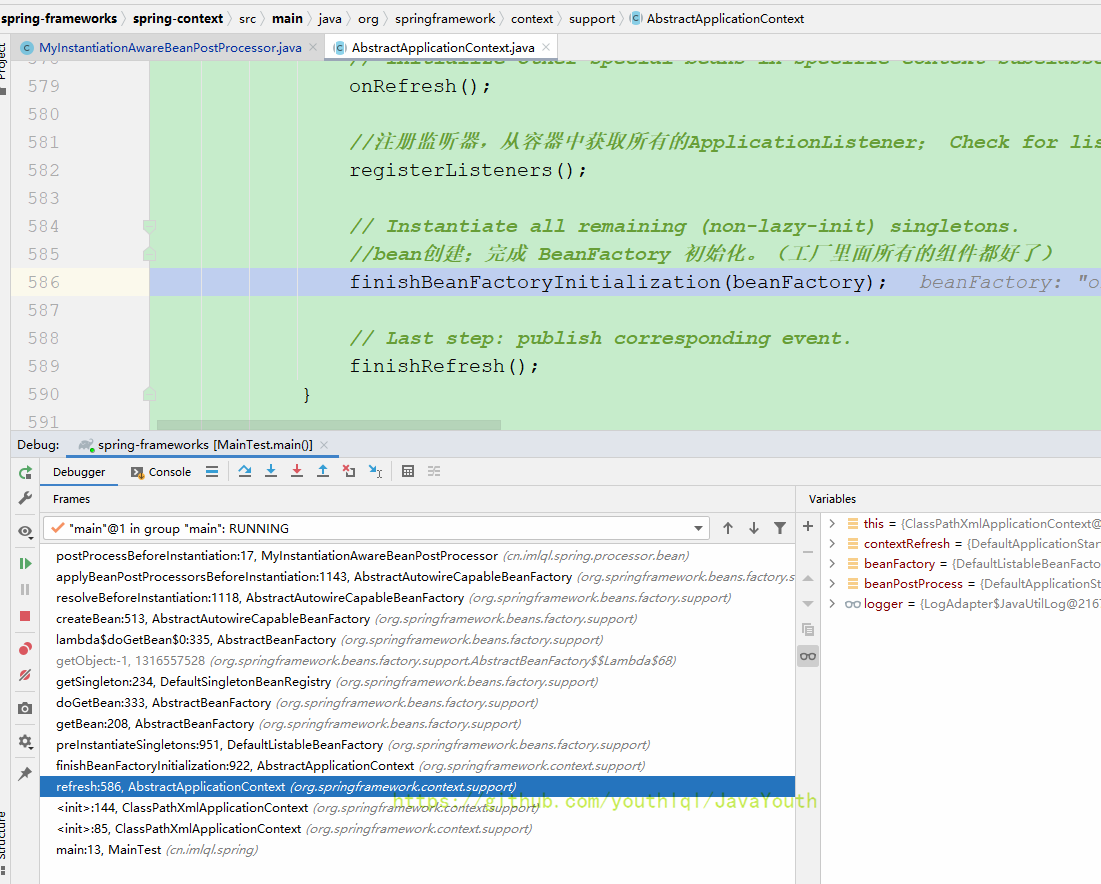 #### AbstractApplicationContext#finishBeanFactoryInitialization()完成BeanFactory初始化
```java
protected void finishBeanFactoryInitialization(ConfigurableListableBeanFactory beanFactory) {
// 给工厂设置好 ConversionService【负责类型转换的组件服务】, Initialize conversion service for this context.
if (beanFactory.containsBean(CONVERSION_SERVICE_BEAN_NAME) &&
beanFactory.isTypeMatch(CONVERSION_SERVICE_BEAN_NAME, ConversionService.class)) {
beanFactory.setConversionService(
beanFactory.getBean(CONVERSION_SERVICE_BEAN_NAME, ConversionService.class));
}
// 注册一个默认的值解析器("${}") ;Register a default embedded value resolver if no BeanFactoryPostProcessor
// (such as a PropertySourcesPlaceholderConfigurer bean) registered any before:
// at this point, primarily for resolution in annotation attribute values.
if (!beanFactory.hasEmbeddedValueResolver()) {
beanFactory.addEmbeddedValueResolver(strVal -> getEnvironment().resolvePlaceholders(strVal));
}
// LoadTimeWeaverAware;aspectj:加载时织入功能【aop】。 Initialize LoadTimeWeaverAware beans early to allow for registering their transformers early.
String[] weaverAwareNames = beanFactory.getBeanNamesForType(LoadTimeWeaverAware.class, false, false);
for (String weaverAwareName : weaverAwareNames) {
getBean(weaverAwareName); //从容器中获取组件,有则直接获取,没则进行创建
}
// Stop using the temporary ClassLoader for type matching.
beanFactory.setTempClassLoader(null);
// Allow for caching all bean definition metadata, not expecting further changes.
beanFactory.freezeConfiguration();
// Instantiate all remaining (non-lazy-init) singletons.
//初始化所有的非懒加载的单实例Bean
beanFactory.preInstantiateSingletons();
}
```
1. 前面刚说过只要调用`getBeanNamesForType`,就会经过`SmartInstantiationAwareBeanPostProcessor`的处理。
```java
//注册监听器,从容器中获取所有的ApplicationListener; Check for listener beans and register them.
registerListeners();
// Instantiate all remaining (non-lazy-init) singletons.
//bean创建;完成 BeanFactory 初始化。(工厂里面所有的组件都好了)
finishBeanFactoryInitialization(beanFactory);
```
这两方法都调用了`getBeanNamesForType`,所以上面Cat会打印两次
2. 上面我们也看了只有Cat的对象还没创建,还没初始化,所以下面就开始创建对象了。
#### AbstractApplicationContext#finishBeanFactoryInitialization()完成BeanFactory初始化
```java
protected void finishBeanFactoryInitialization(ConfigurableListableBeanFactory beanFactory) {
// 给工厂设置好 ConversionService【负责类型转换的组件服务】, Initialize conversion service for this context.
if (beanFactory.containsBean(CONVERSION_SERVICE_BEAN_NAME) &&
beanFactory.isTypeMatch(CONVERSION_SERVICE_BEAN_NAME, ConversionService.class)) {
beanFactory.setConversionService(
beanFactory.getBean(CONVERSION_SERVICE_BEAN_NAME, ConversionService.class));
}
// 注册一个默认的值解析器("${}") ;Register a default embedded value resolver if no BeanFactoryPostProcessor
// (such as a PropertySourcesPlaceholderConfigurer bean) registered any before:
// at this point, primarily for resolution in annotation attribute values.
if (!beanFactory.hasEmbeddedValueResolver()) {
beanFactory.addEmbeddedValueResolver(strVal -> getEnvironment().resolvePlaceholders(strVal));
}
// LoadTimeWeaverAware;aspectj:加载时织入功能【aop】。 Initialize LoadTimeWeaverAware beans early to allow for registering their transformers early.
String[] weaverAwareNames = beanFactory.getBeanNamesForType(LoadTimeWeaverAware.class, false, false);
for (String weaverAwareName : weaverAwareNames) {
getBean(weaverAwareName); //从容器中获取组件,有则直接获取,没则进行创建
}
// Stop using the temporary ClassLoader for type matching.
beanFactory.setTempClassLoader(null);
// Allow for caching all bean definition metadata, not expecting further changes.
beanFactory.freezeConfiguration();
// Instantiate all remaining (non-lazy-init) singletons.
//初始化所有的非懒加载的单实例Bean
beanFactory.preInstantiateSingletons();
}
```
1. 前面刚说过只要调用`getBeanNamesForType`,就会经过`SmartInstantiationAwareBeanPostProcessor`的处理。
```java
//注册监听器,从容器中获取所有的ApplicationListener; Check for listener beans and register them.
registerListeners();
// Instantiate all remaining (non-lazy-init) singletons.
//bean创建;完成 BeanFactory 初始化。(工厂里面所有的组件都好了)
finishBeanFactoryInitialization(beanFactory);
```
这两方法都调用了`getBeanNamesForType`,所以上面Cat会打印两次
2. 上面我们也看了只有Cat的对象还没创建,还没初始化,所以下面就开始创建对象了。
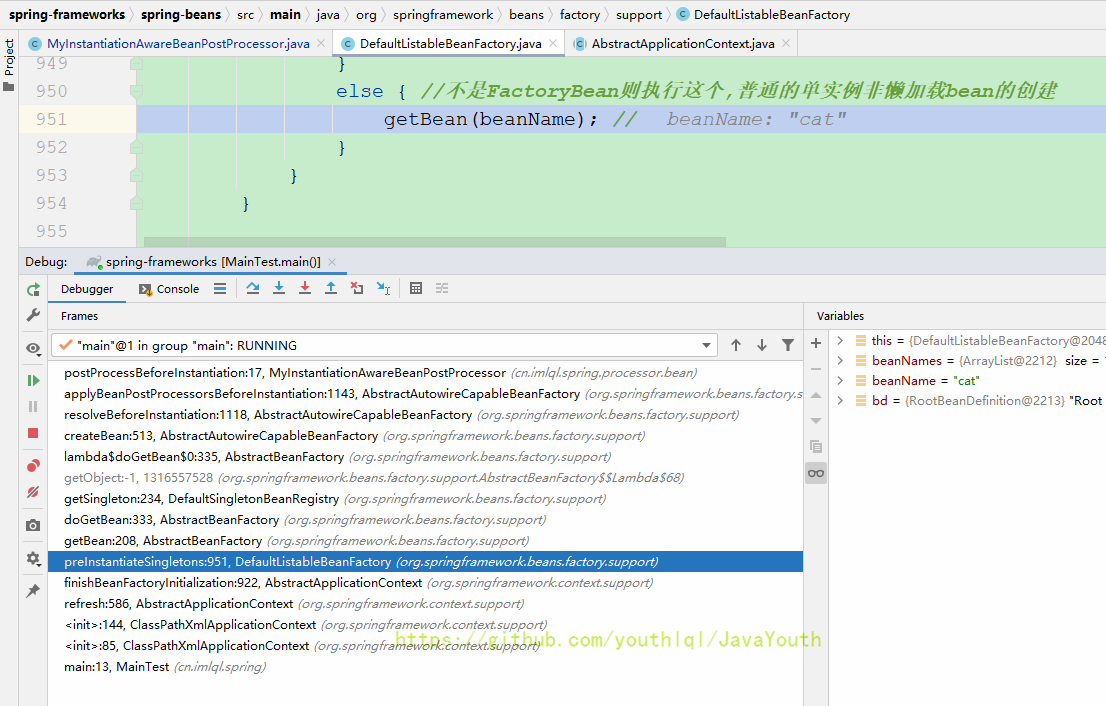 #### AbstractAutowireCapableBeanFactory#createBean()创建Bean
```java
protected Object createBean(String beanName, RootBeanDefinition mbd, @Nullable Object[] args)
throws BeanCreationException {
if (logger.isTraceEnabled()) {
logger.trace("Creating instance of bean '" + beanName + "'");
}
RootBeanDefinition mbdToUse = mbd;
// Make sure bean class is actually resolved at this point, and
// clone the bean definition in case of a dynamically resolved Class
// which cannot be stored in the shared merged bean definition.
Class resolvedClass = resolveBeanClass(mbd, beanName);
if (resolvedClass != null && !mbd.hasBeanClass() && mbd.getBeanClassName() != null) {
mbdToUse = new RootBeanDefinition(mbd);
mbdToUse.setBeanClass(resolvedClass);
}
// Prepare method overrides.
try {
mbdToUse.prepareMethodOverrides();
}
catch (BeanDefinitionValidationException ex) {
throw new BeanDefinitionStoreException(mbdToUse.getResourceDescription(),
beanName, "Validation of method overrides failed", ex);
}
try {
// 提前给我们一个机会,去返回组件的代理对象。 Give BeanPostProcessors a chance to return a proxy instead of the target bean instance.
Object bean = resolveBeforeInstantiation(beanName, mbdToUse);
if (bean != null) {
return bean;
}
}
catch (Throwable ex) {
throw new BeanCreationException(mbdToUse.getResourceDescription(), beanName,
"BeanPostProcessor before instantiation of bean failed", ex);
}
try { //Spring真正自己创建对象
Object beanInstance = doCreateBean(beanName, mbdToUse, args);
if (logger.isTraceEnabled()) {
logger.trace("Finished creating instance of bean '" + beanName + "'");
}
return beanInstance;
}
catch (BeanCreationException | ImplicitlyAppearedSingletonException ex) {
// A previously detected exception with proper bean creation context already,
// or illegal singleton state to be communicated up to DefaultSingletonBeanRegistry.
throw ex;
}
catch (Throwable ex) {
throw new BeanCreationException(
mbdToUse.getResourceDescription(), beanName, "Unexpected exception during bean creation", ex);
}
}
@Nullable
protected Object resolveBeforeInstantiation(String beanName, RootBeanDefinition mbd) {
Object bean = null;
if (!Boolean.FALSE.equals(mbd.beforeInstantiationResolved)) {
// Make sure bean class is actually resolved at this point.
if (!mbd.isSynthetic() && hasInstantiationAwareBeanPostProcessors()) {
Class targetType = determineTargetType(beanName, mbd);
if (targetType != null) {
bean = applyBeanPostProcessorsBeforeInstantiation(targetType, beanName);
if (bean != null) {
bean = applyBeanPostProcessorsAfterInitialization(bean, beanName);
}
}
}
mbd.beforeInstantiationResolved = (bean != null);
}
return bean;
}
@Nullable
protected Object applyBeanPostProcessorsBeforeInstantiation(Class beanClass, String beanName) {
for (InstantiationAwareBeanPostProcessor bp : getBeanPostProcessorCache().instantiationAware) {
Object result = bp.postProcessBeforeInstantiation(beanClass, beanName); //还是老样子,调用我们自己写的InstantiationAwareBeanPostProcessor
if (result != null) {
return result;
}
}
return null;
}
```
#### 此方法能做什么?
后置处理器在此处提前给我们一个机会,去返回组件的代理对象
```java
public Object postProcessBeforeInstantiation(Class beanClass, String beanName) throws BeansException {
System.out.println("MyInstantiationAwareBeanPostProcessor...postProcessBeforeInstantiation=>" + beanClass + "--" + beanName); //if(class.isAssFrom(Cat.class)){return new Dog()}
return null; //如果我们自己创建了对象返回。Spring则不会帮我们创建对象,用我们自己创建的对象(可以是代理对象)
}
```
### SmartInstantiationAwareBeanPostProcessor-执行determineCandidateConstructors方法
#### Debug调用栈
#### AbstractAutowireCapableBeanFactory#createBean()创建Bean
```java
protected Object createBean(String beanName, RootBeanDefinition mbd, @Nullable Object[] args)
throws BeanCreationException {
if (logger.isTraceEnabled()) {
logger.trace("Creating instance of bean '" + beanName + "'");
}
RootBeanDefinition mbdToUse = mbd;
// Make sure bean class is actually resolved at this point, and
// clone the bean definition in case of a dynamically resolved Class
// which cannot be stored in the shared merged bean definition.
Class resolvedClass = resolveBeanClass(mbd, beanName);
if (resolvedClass != null && !mbd.hasBeanClass() && mbd.getBeanClassName() != null) {
mbdToUse = new RootBeanDefinition(mbd);
mbdToUse.setBeanClass(resolvedClass);
}
// Prepare method overrides.
try {
mbdToUse.prepareMethodOverrides();
}
catch (BeanDefinitionValidationException ex) {
throw new BeanDefinitionStoreException(mbdToUse.getResourceDescription(),
beanName, "Validation of method overrides failed", ex);
}
try {
// 提前给我们一个机会,去返回组件的代理对象。 Give BeanPostProcessors a chance to return a proxy instead of the target bean instance.
Object bean = resolveBeforeInstantiation(beanName, mbdToUse);
if (bean != null) {
return bean;
}
}
catch (Throwable ex) {
throw new BeanCreationException(mbdToUse.getResourceDescription(), beanName,
"BeanPostProcessor before instantiation of bean failed", ex);
}
try { //Spring真正自己创建对象
Object beanInstance = doCreateBean(beanName, mbdToUse, args);
if (logger.isTraceEnabled()) {
logger.trace("Finished creating instance of bean '" + beanName + "'");
}
return beanInstance;
}
catch (BeanCreationException | ImplicitlyAppearedSingletonException ex) {
// A previously detected exception with proper bean creation context already,
// or illegal singleton state to be communicated up to DefaultSingletonBeanRegistry.
throw ex;
}
catch (Throwable ex) {
throw new BeanCreationException(
mbdToUse.getResourceDescription(), beanName, "Unexpected exception during bean creation", ex);
}
}
@Nullable
protected Object resolveBeforeInstantiation(String beanName, RootBeanDefinition mbd) {
Object bean = null;
if (!Boolean.FALSE.equals(mbd.beforeInstantiationResolved)) {
// Make sure bean class is actually resolved at this point.
if (!mbd.isSynthetic() && hasInstantiationAwareBeanPostProcessors()) {
Class targetType = determineTargetType(beanName, mbd);
if (targetType != null) {
bean = applyBeanPostProcessorsBeforeInstantiation(targetType, beanName);
if (bean != null) {
bean = applyBeanPostProcessorsAfterInitialization(bean, beanName);
}
}
}
mbd.beforeInstantiationResolved = (bean != null);
}
return bean;
}
@Nullable
protected Object applyBeanPostProcessorsBeforeInstantiation(Class beanClass, String beanName) {
for (InstantiationAwareBeanPostProcessor bp : getBeanPostProcessorCache().instantiationAware) {
Object result = bp.postProcessBeforeInstantiation(beanClass, beanName); //还是老样子,调用我们自己写的InstantiationAwareBeanPostProcessor
if (result != null) {
return result;
}
}
return null;
}
```
#### 此方法能做什么?
后置处理器在此处提前给我们一个机会,去返回组件的代理对象
```java
public Object postProcessBeforeInstantiation(Class beanClass, String beanName) throws BeansException {
System.out.println("MyInstantiationAwareBeanPostProcessor...postProcessBeforeInstantiation=>" + beanClass + "--" + beanName); //if(class.isAssFrom(Cat.class)){return new Dog()}
return null; //如果我们自己创建了对象返回。Spring则不会帮我们创建对象,用我们自己创建的对象(可以是代理对象)
}
```
### SmartInstantiationAwareBeanPostProcessor-执行determineCandidateConstructors方法
#### Debug调用栈
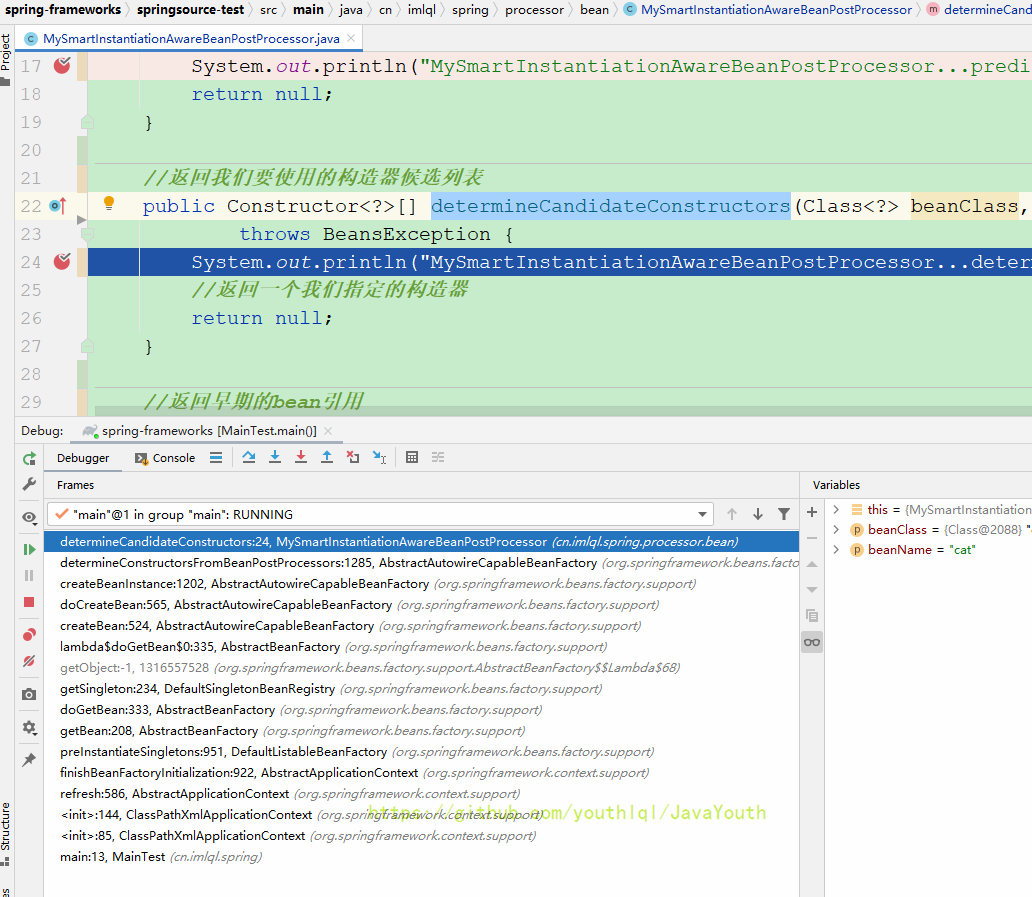 > 前面还是一样的执行逻辑,直接来到下面
#### AbstractAutowireCapableBeanFactory#doCreateBean()无参构造创建Bean,属性赋值,初始化等
```java
protected Object doCreateBean(String beanName, RootBeanDefinition mbd, @Nullable Object[] args)
throws BeanCreationException {
// Instantiate the bean.
BeanWrapper instanceWrapper = null;
if (mbd.isSingleton()) { //是否单例的
instanceWrapper = this.factoryBeanInstanceCache.remove(beanName);
}
if (instanceWrapper == null) {
//创建Bean的实例,默认使用无参构造器创建的对象,组件的原始对象就创建了
instanceWrapper = createBeanInstance(beanName, mbd, args);
}
Object bean = instanceWrapper.getWrappedInstance();
Class beanType = instanceWrapper.getWrappedClass();
if (beanType != NullBean.class) {
mbd.resolvedTargetType = beanType;
}
//允许 后置处理器 再来修改下beanDefinition;MergedBeanDefinitionPostProcessor.postProcessMergedBeanDefinition;; Allow post-processors to modify the merged bean definition.
synchronized (mbd.postProcessingLock) {
if (!mbd.postProcessed) {
try {
applyMergedBeanDefinitionPostProcessors(mbd, beanType, beanName);
}
catch (Throwable ex) {
throw new BeanCreationException(mbd.getResourceDescription(), beanName,
"Post-processing of merged bean definition failed", ex);
}
mbd.postProcessed = true;
}
}
// Eagerly cache singletons to be able to resolve circular references
// even when triggered by lifecycle interfaces like BeanFactoryAware.
boolean earlySingletonExposure = (mbd.isSingleton() && this.allowCircularReferences &&
isSingletonCurrentlyInCreation(beanName));
if (earlySingletonExposure) {
if (logger.isTraceEnabled()) {
logger.trace("Eagerly caching bean '" + beanName +
"' to allow for resolving potential circular references");
}
addSingletonFactory(beanName, () -> getEarlyBeanReference(beanName, mbd, bean));
}
// Initialize the bean instance.
Object exposedObject = bean;
try {
populateBean(beanName, mbd, instanceWrapper); //给创建好的对象每个属性进行赋值,@Autowired发生在这里
exposedObject = initializeBean(beanName, exposedObject, mbd);//初始化bean
}
// ......
return exposedObject;
}
```
#### AbstractAutowireCapableBeanFactory#createBeanInstance()使用构造器创建Bean
```java
protected BeanWrapper createBeanInstance(String beanName, RootBeanDefinition mbd, @Nullable Object[] args) {
//获取Bean的类型 Make sure bean class is actually resolved at this point.
Class beanClass = resolveBeanClass(mbd, beanName);
if (beanClass != null && !Modifier.isPublic(beanClass.getModifiers()) && !mbd.isNonPublicAccessAllowed()) {
throw new BeanCreationException(mbd.getResourceDescription(), beanName,
"Bean class isn't public, and non-public access not allowed: " + beanClass.getName());
}
//定义Bean的实例提供者
Supplier instanceSupplier = mbd.getInstanceSupplier();
if (instanceSupplier != null) {
return obtainFromSupplier(instanceSupplier, beanName);
}
//@Bean注解等可能会调用此方法进行创建出来,Spring把@Bean标注的方法理解为工厂方法
if (mbd.getFactoryMethodName() != null) {
return instantiateUsingFactoryMethod(beanName, mbd, args);
}
//快速创建? Shortcut when re-creating the same bean...
boolean resolved = false;
boolean autowireNecessary = false;
if (args == null) {
synchronized (mbd.constructorArgumentLock) {
if (mbd.resolvedConstructorOrFactoryMethod != null) {
resolved = true;
autowireNecessary = mbd.constructorArgumentsResolved;
}
}
}
if (resolved) {
if (autowireNecessary) {
return autowireConstructor(beanName, mbd, null, null);
}
else {
return instantiateBean(beanName, mbd);
}
}
//后置处理器有机会在这里决定当前bean用哪个构造器?SmartInstantiationAwareBeanPostProcessor.determineCandidateConstructors() Candidate constructors for autowiring?
Constructor[] ctors = determineConstructorsFromBeanPostProcessors(beanClass, beanName);
if (ctors != null || mbd.getResolvedAutowireMode() == AUTOWIRE_CONSTRUCTOR ||
mbd.hasConstructorArgumentValues() || !ObjectUtils.isEmpty(args)) {
return autowireConstructor(beanName, mbd, ctors, args); //构造器方式的自动注入与对象创建
}
//使用默认的自己设置的高优先级的构造器 Preferred constructors for default construction?
ctors = mbd.getPreferredConstructors();
if (ctors != null) {
return autowireConstructor(beanName, mbd, ctors, null);
}
// 默认使用无参构造器为当前组件创建对象;No special handling: simply use no-arg constructor.
return instantiateBean(beanName, mbd);
}
@Nullable
protected Constructor[] determineConstructorsFromBeanPostProcessors(@Nullable Class beanClass, String beanName)
throws BeansException {
if (beanClass != null && hasInstantiationAwareBeanPostProcessors()) {
for (SmartInstantiationAwareBeanPostProcessor bp : getBeanPostProcessorCache().smartInstantiationAware) {
Constructor[] ctors = bp.determineCandidateConstructors(beanClass, beanName);// 一样的,调我们自定义的
if (ctors != null) {
return ctors;
}
}
}
return null;
}
```
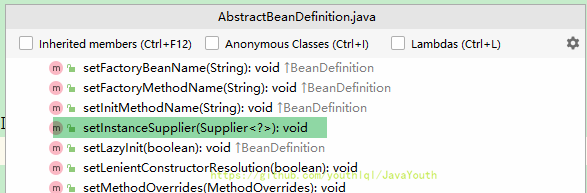
1. 实例提供者:
> 前面还是一样的执行逻辑,直接来到下面
#### AbstractAutowireCapableBeanFactory#doCreateBean()无参构造创建Bean,属性赋值,初始化等
```java
protected Object doCreateBean(String beanName, RootBeanDefinition mbd, @Nullable Object[] args)
throws BeanCreationException {
// Instantiate the bean.
BeanWrapper instanceWrapper = null;
if (mbd.isSingleton()) { //是否单例的
instanceWrapper = this.factoryBeanInstanceCache.remove(beanName);
}
if (instanceWrapper == null) {
//创建Bean的实例,默认使用无参构造器创建的对象,组件的原始对象就创建了
instanceWrapper = createBeanInstance(beanName, mbd, args);
}
Object bean = instanceWrapper.getWrappedInstance();
Class beanType = instanceWrapper.getWrappedClass();
if (beanType != NullBean.class) {
mbd.resolvedTargetType = beanType;
}
//允许 后置处理器 再来修改下beanDefinition;MergedBeanDefinitionPostProcessor.postProcessMergedBeanDefinition;; Allow post-processors to modify the merged bean definition.
synchronized (mbd.postProcessingLock) {
if (!mbd.postProcessed) {
try {
applyMergedBeanDefinitionPostProcessors(mbd, beanType, beanName);
}
catch (Throwable ex) {
throw new BeanCreationException(mbd.getResourceDescription(), beanName,
"Post-processing of merged bean definition failed", ex);
}
mbd.postProcessed = true;
}
}
// Eagerly cache singletons to be able to resolve circular references
// even when triggered by lifecycle interfaces like BeanFactoryAware.
boolean earlySingletonExposure = (mbd.isSingleton() && this.allowCircularReferences &&
isSingletonCurrentlyInCreation(beanName));
if (earlySingletonExposure) {
if (logger.isTraceEnabled()) {
logger.trace("Eagerly caching bean '" + beanName +
"' to allow for resolving potential circular references");
}
addSingletonFactory(beanName, () -> getEarlyBeanReference(beanName, mbd, bean));
}
// Initialize the bean instance.
Object exposedObject = bean;
try {
populateBean(beanName, mbd, instanceWrapper); //给创建好的对象每个属性进行赋值,@Autowired发生在这里
exposedObject = initializeBean(beanName, exposedObject, mbd);//初始化bean
}
// ......
return exposedObject;
}
```
#### AbstractAutowireCapableBeanFactory#createBeanInstance()使用构造器创建Bean
```java
protected BeanWrapper createBeanInstance(String beanName, RootBeanDefinition mbd, @Nullable Object[] args) {
//获取Bean的类型 Make sure bean class is actually resolved at this point.
Class beanClass = resolveBeanClass(mbd, beanName);
if (beanClass != null && !Modifier.isPublic(beanClass.getModifiers()) && !mbd.isNonPublicAccessAllowed()) {
throw new BeanCreationException(mbd.getResourceDescription(), beanName,
"Bean class isn't public, and non-public access not allowed: " + beanClass.getName());
}
//定义Bean的实例提供者
Supplier instanceSupplier = mbd.getInstanceSupplier();
if (instanceSupplier != null) {
return obtainFromSupplier(instanceSupplier, beanName);
}
//@Bean注解等可能会调用此方法进行创建出来,Spring把@Bean标注的方法理解为工厂方法
if (mbd.getFactoryMethodName() != null) {
return instantiateUsingFactoryMethod(beanName, mbd, args);
}
//快速创建? Shortcut when re-creating the same bean...
boolean resolved = false;
boolean autowireNecessary = false;
if (args == null) {
synchronized (mbd.constructorArgumentLock) {
if (mbd.resolvedConstructorOrFactoryMethod != null) {
resolved = true;
autowireNecessary = mbd.constructorArgumentsResolved;
}
}
}
if (resolved) {
if (autowireNecessary) {
return autowireConstructor(beanName, mbd, null, null);
}
else {
return instantiateBean(beanName, mbd);
}
}
//后置处理器有机会在这里决定当前bean用哪个构造器?SmartInstantiationAwareBeanPostProcessor.determineCandidateConstructors() Candidate constructors for autowiring?
Constructor[] ctors = determineConstructorsFromBeanPostProcessors(beanClass, beanName);
if (ctors != null || mbd.getResolvedAutowireMode() == AUTOWIRE_CONSTRUCTOR ||
mbd.hasConstructorArgumentValues() || !ObjectUtils.isEmpty(args)) {
return autowireConstructor(beanName, mbd, ctors, args); //构造器方式的自动注入与对象创建
}
//使用默认的自己设置的高优先级的构造器 Preferred constructors for default construction?
ctors = mbd.getPreferredConstructors();
if (ctors != null) {
return autowireConstructor(beanName, mbd, ctors, null);
}
// 默认使用无参构造器为当前组件创建对象;No special handling: simply use no-arg constructor.
return instantiateBean(beanName, mbd);
}
@Nullable
protected Constructor[] determineConstructorsFromBeanPostProcessors(@Nullable Class beanClass, String beanName)
throws BeansException {
if (beanClass != null && hasInstantiationAwareBeanPostProcessors()) {
for (SmartInstantiationAwareBeanPostProcessor bp : getBeanPostProcessorCache().smartInstantiationAware) {
Constructor[] ctors = bp.determineCandidateConstructors(beanClass, beanName);// 一样的,调我们自定义的
if (ctors != null) {
return ctors;
}
}
}
return null;
}
```
1. 实例提供者:
 #### 此方法能做什么?
后置处理器有机会在这里决定当前bean用哪个构造器
```java
//返回我们要使用的构造器候选列表
public Constructor[] determineCandidateConstructors(Class beanClass, String beanName)
throws BeansException {
System.out.println("MySmartInstantiationAwareBeanPostProcessor...determineCandidateConstructors=>" + beanClass + "--" + beanName);
//返回一个我们指定的构造器
return null;
}
```
### Cat-执行无参构造方法
#### 此方法能做什么?
后置处理器有机会在这里决定当前bean用哪个构造器
```java
//返回我们要使用的构造器候选列表
public Constructor[] determineCandidateConstructors(Class beanClass, String beanName)
throws BeansException {
System.out.println("MySmartInstantiationAwareBeanPostProcessor...determineCandidateConstructors=>" + beanClass + "--" + beanName);
//返回一个我们指定的构造器
return null;
}
```
### Cat-执行无参构造方法
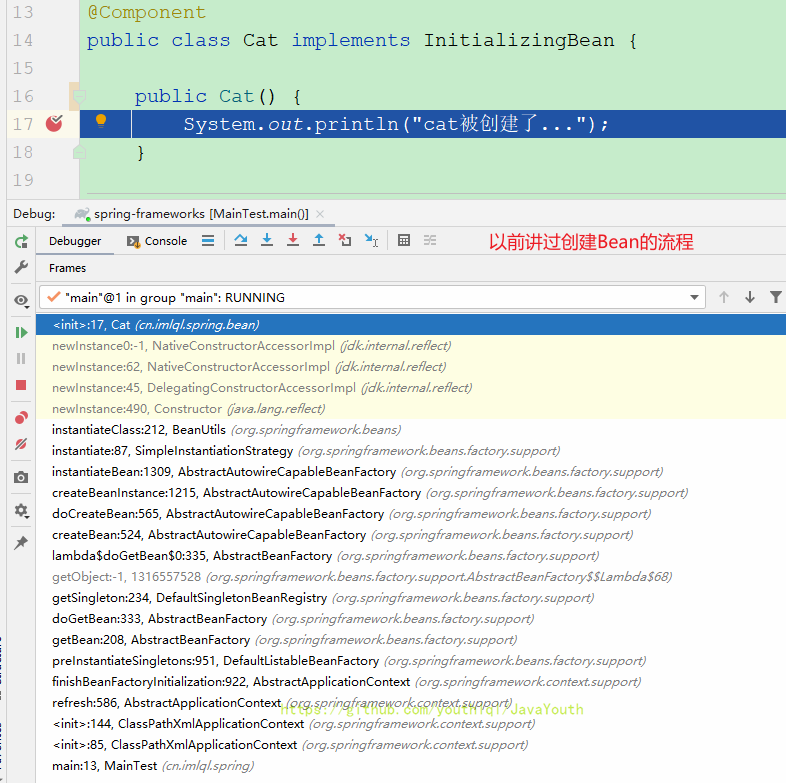 以前讲过。
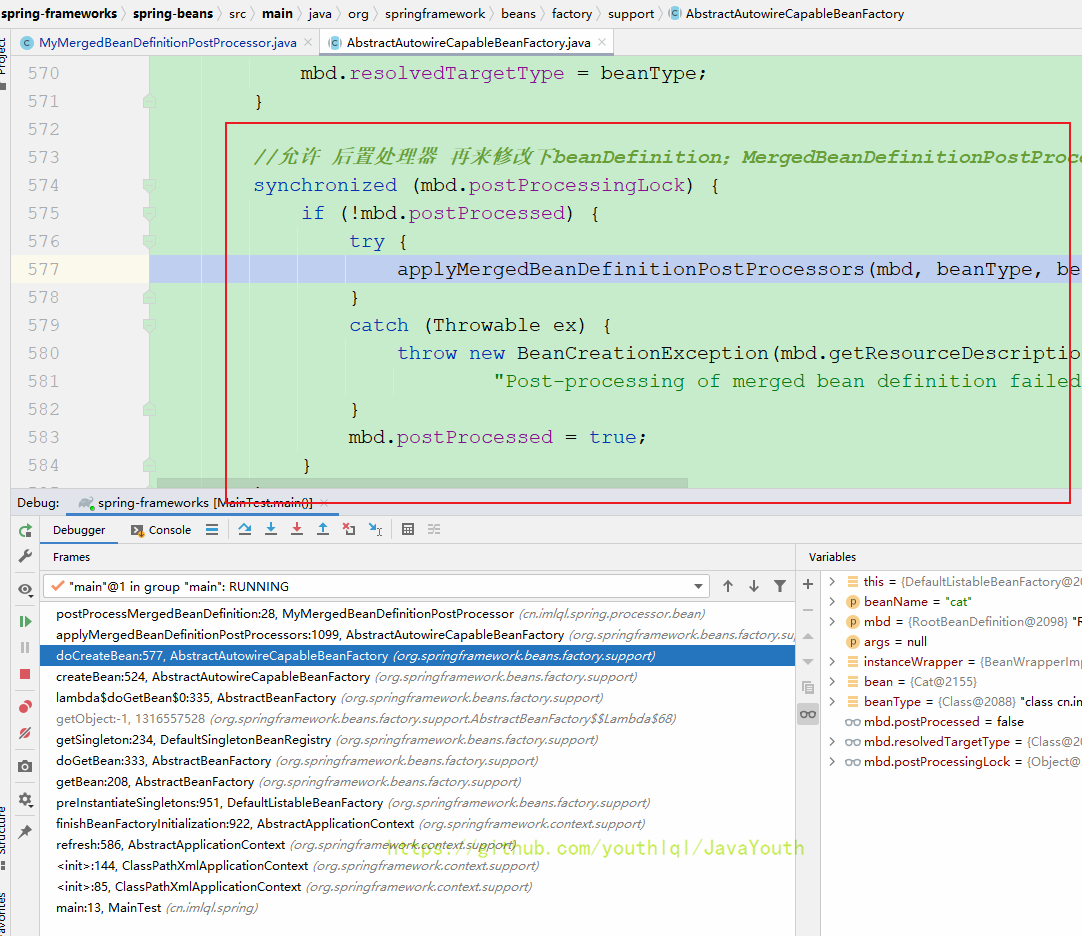
### MergedBeanDefinitionPostProcessor-执行postProcessMergedBeanDefinition方法
#### Debug调用栈
以前讲过。
### MergedBeanDefinitionPostProcessor-执行postProcessMergedBeanDefinition方法
#### Debug调用栈
 #### 此方法能做什么?
看这个传进来的参数,应该就是能修改下beanDefinition
```java
public void postProcessMergedBeanDefinition(RootBeanDefinition beanDefinition, Class beanType, String beanName) {
System.out.println("MyMergedBeanDefinitionPostProcessor...postProcessMergedBeanDefinition..=>" + beanName + "--" + beanType + "---" + beanDefinition);
}
```
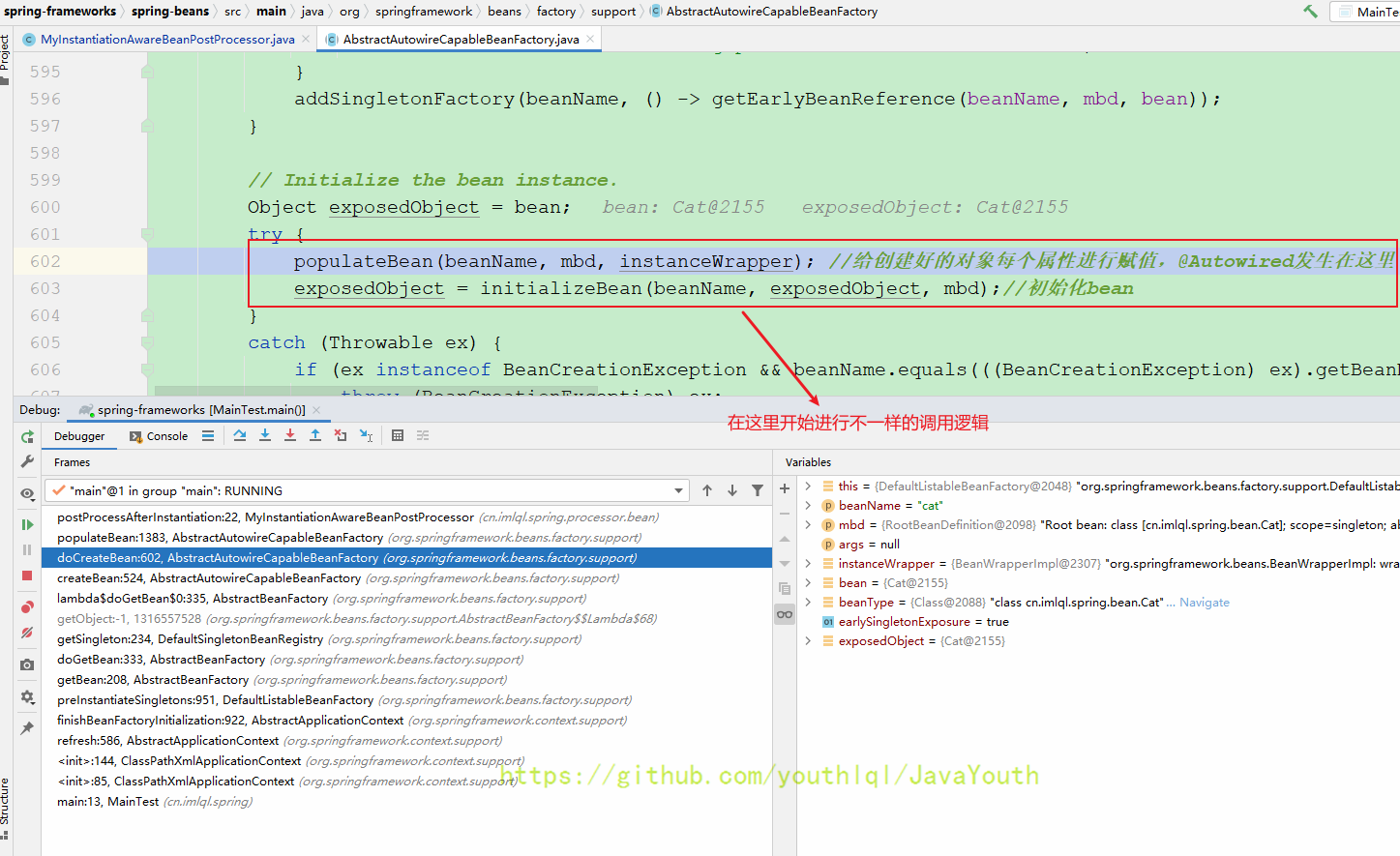
### InstantiationAwareBeanPostProcessor-执行postProcessAfterInstantiation方法
#### Debug调用栈
#### 此方法能做什么?
看这个传进来的参数,应该就是能修改下beanDefinition
```java
public void postProcessMergedBeanDefinition(RootBeanDefinition beanDefinition, Class beanType, String beanName) {
System.out.println("MyMergedBeanDefinitionPostProcessor...postProcessMergedBeanDefinition..=>" + beanName + "--" + beanType + "---" + beanDefinition);
}
```
### InstantiationAwareBeanPostProcessor-执行postProcessAfterInstantiation方法
#### Debug调用栈
 #### AbstractAutowireCapableBeanFactory#populateBean()属性赋值
```java
protected void populateBean(String beanName, RootBeanDefinition mbd, @Nullable BeanWrapper bw) {
if (bw == null) {
if (mbd.hasPropertyValues()) {
throw new BeanCreationException(
mbd.getResourceDescription(), beanName, "Cannot apply property values to null instance");
}
else {
// Skip property population phase for null instance.
return;
}
}
// @Autowired赋值也在这里(但是没做事)。可以中断初始化行为; 在属性赋值之前,后置处理器可以提前准备些东西 Give any InstantiationAwareBeanPostProcessors the opportunity to modify the
// state of the bean before properties are set. This can be used, for example,
// to support styles of field injection.
if (!mbd.isSynthetic() && hasInstantiationAwareBeanPostProcessors()) {
for (InstantiationAwareBeanPostProcessor bp : getBeanPostProcessorCache().instantiationAware) {
if (!bp.postProcessAfterInstantiation(bw.getWrappedInstance(), beanName)) {
return;
}
}
} //以上的后置处理器可以中断以下的行为
PropertyValues pvs = (mbd.hasPropertyValues() ? mbd.getPropertyValues() : null);
int resolvedAutowireMode = mbd.getResolvedAutowireMode();
if (resolvedAutowireMode == AUTOWIRE_BY_NAME || resolvedAutowireMode == AUTOWIRE_BY_TYPE) {
MutablePropertyValues newPvs = new MutablePropertyValues(pvs);
// Add property values based on autowire by name if applicable.
if (resolvedAutowireMode == AUTOWIRE_BY_NAME) {
autowireByName(beanName, mbd, bw, newPvs);
}
// Add property values based on autowire by type if applicable.
if (resolvedAutowireMode == AUTOWIRE_BY_TYPE) {
autowireByType(beanName, mbd, bw, newPvs);
}
pvs = newPvs;
}
boolean hasInstAwareBpps = hasInstantiationAwareBeanPostProcessors();
boolean needsDepCheck = (mbd.getDependencyCheck() != AbstractBeanDefinition.DEPENDENCY_CHECK_NONE);
PropertyDescriptor[] filteredPds = null;
if (hasInstAwareBpps) {
if (pvs == null) {
pvs = mbd.getPropertyValues(); //xml中property标签指定的
} //使用后置处理器处理属性
for (InstantiationAwareBeanPostProcessor bp : getBeanPostProcessorCache().instantiationAware) {
PropertyValues pvsToUse = bp.postProcessProperties(pvs, bw.getWrappedInstance(), beanName);
if (pvsToUse == null) {
if (filteredPds == null) {
filteredPds = filterPropertyDescriptorsForDependencyCheck(bw, mbd.allowCaching);
}
pvsToUse = bp.postProcessPropertyValues(pvs, filteredPds, bw.getWrappedInstance(), beanName);
if (pvsToUse == null) {
return;
}
}
pvs = pvsToUse; //封装了当前bean的所有属性名和值,可以由后置处理器处理得到
}
// 在这里设置过的属性,在后面就不用处理了
}
if (needsDepCheck) {
if (filteredPds == null) {
filteredPds = filterPropertyDescriptorsForDependencyCheck(bw, mbd.allowCaching);
}
checkDependencies(beanName, mbd, filteredPds, pvs);
}
if (pvs != null) { //把以前处理好的PropertyValues给bean里面设置一下。主要是上面步骤没有给bean里面设置的属性
applyPropertyValues(beanName, mbd, bw, pvs); //xml版的所有配置会来到这里给属性赋值
}
}
```
#### AbstractAutowireCapableBeanFactory#populateBean()属性赋值
```java
protected void populateBean(String beanName, RootBeanDefinition mbd, @Nullable BeanWrapper bw) {
if (bw == null) {
if (mbd.hasPropertyValues()) {
throw new BeanCreationException(
mbd.getResourceDescription(), beanName, "Cannot apply property values to null instance");
}
else {
// Skip property population phase for null instance.
return;
}
}
// @Autowired赋值也在这里(但是没做事)。可以中断初始化行为; 在属性赋值之前,后置处理器可以提前准备些东西 Give any InstantiationAwareBeanPostProcessors the opportunity to modify the
// state of the bean before properties are set. This can be used, for example,
// to support styles of field injection.
if (!mbd.isSynthetic() && hasInstantiationAwareBeanPostProcessors()) {
for (InstantiationAwareBeanPostProcessor bp : getBeanPostProcessorCache().instantiationAware) {
if (!bp.postProcessAfterInstantiation(bw.getWrappedInstance(), beanName)) {
return;
}
}
} //以上的后置处理器可以中断以下的行为
PropertyValues pvs = (mbd.hasPropertyValues() ? mbd.getPropertyValues() : null);
int resolvedAutowireMode = mbd.getResolvedAutowireMode();
if (resolvedAutowireMode == AUTOWIRE_BY_NAME || resolvedAutowireMode == AUTOWIRE_BY_TYPE) {
MutablePropertyValues newPvs = new MutablePropertyValues(pvs);
// Add property values based on autowire by name if applicable.
if (resolvedAutowireMode == AUTOWIRE_BY_NAME) {
autowireByName(beanName, mbd, bw, newPvs);
}
// Add property values based on autowire by type if applicable.
if (resolvedAutowireMode == AUTOWIRE_BY_TYPE) {
autowireByType(beanName, mbd, bw, newPvs);
}
pvs = newPvs;
}
boolean hasInstAwareBpps = hasInstantiationAwareBeanPostProcessors();
boolean needsDepCheck = (mbd.getDependencyCheck() != AbstractBeanDefinition.DEPENDENCY_CHECK_NONE);
PropertyDescriptor[] filteredPds = null;
if (hasInstAwareBpps) {
if (pvs == null) {
pvs = mbd.getPropertyValues(); //xml中property标签指定的
} //使用后置处理器处理属性
for (InstantiationAwareBeanPostProcessor bp : getBeanPostProcessorCache().instantiationAware) {
PropertyValues pvsToUse = bp.postProcessProperties(pvs, bw.getWrappedInstance(), beanName);
if (pvsToUse == null) {
if (filteredPds == null) {
filteredPds = filterPropertyDescriptorsForDependencyCheck(bw, mbd.allowCaching);
}
pvsToUse = bp.postProcessPropertyValues(pvs, filteredPds, bw.getWrappedInstance(), beanName);
if (pvsToUse == null) {
return;
}
}
pvs = pvsToUse; //封装了当前bean的所有属性名和值,可以由后置处理器处理得到
}
// 在这里设置过的属性,在后面就不用处理了
}
if (needsDepCheck) {
if (filteredPds == null) {
filteredPds = filterPropertyDescriptorsForDependencyCheck(bw, mbd.allowCaching);
}
checkDependencies(beanName, mbd, filteredPds, pvs);
}
if (pvs != null) { //把以前处理好的PropertyValues给bean里面设置一下。主要是上面步骤没有给bean里面设置的属性
applyPropertyValues(beanName, mbd, bw, pvs); //xml版的所有配置会来到这里给属性赋值
}
}
```
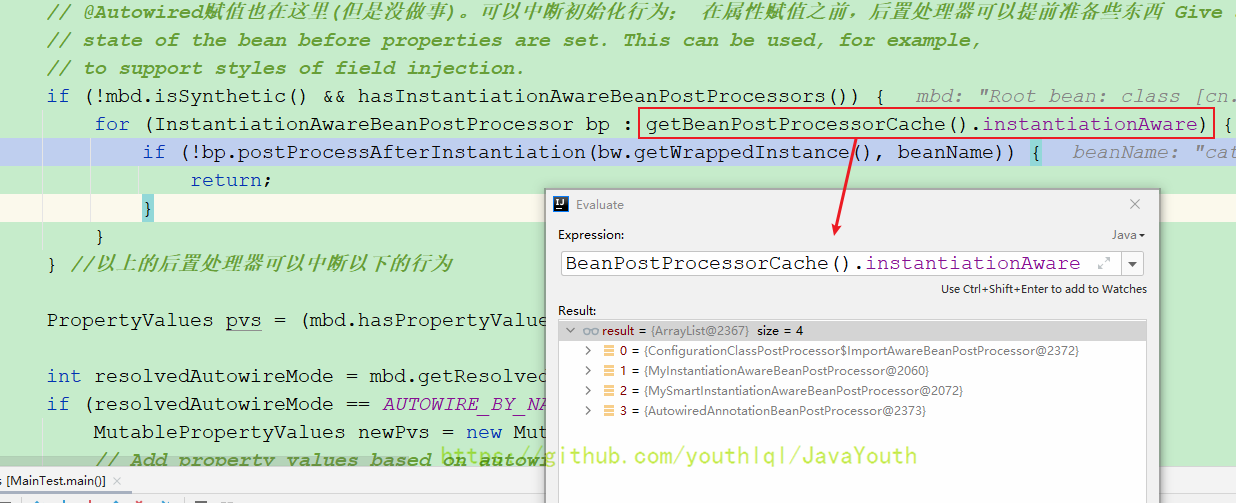 AutowiredAnnotationBeanPostProcessor(处理@Autowire)也在这里,但是直接返回了true,相当于没做事。
#### BeanWrapperImpl#setValue()
`applyPropertyValues(beanName, mbd, bw, pvs);`最终也是用下面的反射进行赋值
```java
@Override //利用set方法反射赋值
public void setValue(@Nullable Object value) throws Exception { //name setName
Method writeMethod = (this.pd instanceof GenericTypeAwarePropertyDescriptor ?
((GenericTypeAwarePropertyDescriptor) this.pd).getWriteMethodForActualAccess() :
this.pd.getWriteMethod());
if (System.getSecurityManager() != null) {
AccessController.doPrivileged((PrivilegedAction
AutowiredAnnotationBeanPostProcessor(处理@Autowire)也在这里,但是直接返回了true,相当于没做事。
#### BeanWrapperImpl#setValue()
`applyPropertyValues(beanName, mbd, bw, pvs);`最终也是用下面的反射进行赋值
```java
@Override //利用set方法反射赋值
public void setValue(@Nullable Object value) throws Exception { //name setName
Method writeMethod = (this.pd instanceof GenericTypeAwarePropertyDescriptor ?
((GenericTypeAwarePropertyDescriptor) this.pd).getWriteMethodForActualAccess() :
this.pd.getWriteMethod());
if (System.getSecurityManager() != null) {
AccessController.doPrivileged((PrivilegedAction